Decoding a TAF: when forecasts beat present weather for flight planning
A METAR tells you what the weather is right now. A TAF tells you what it's going to be for the next 24 or 30 hours. For flight planning more than an hour out, the TAF is the document that matters.
A METAR tells you what the weather is RIGHT NOW at one airport. A TAF tells you what it's GOING TO BE for the next 24 or 30 hours. For flight planning more than an hour out, the TAF is the document that matters. The format is denser than a METAR — it includes time-windowed change groups — but once you can read one you can plan a 4-leg cross-country with confidence. This is the practical guide.
A real TAF, decoded
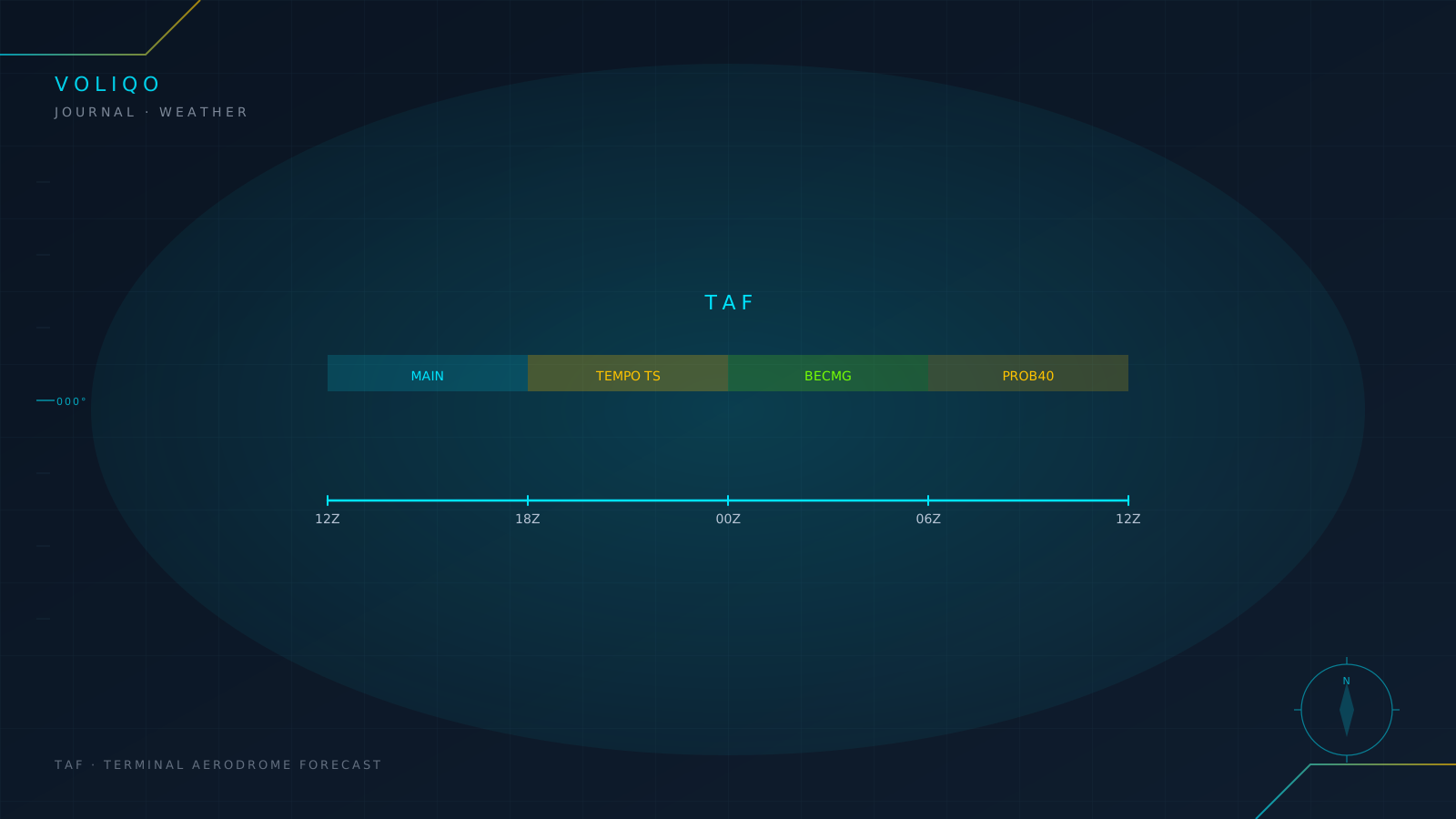
Here's a real TAF from LIRP (Pisa), valid period 14:00–14:00:
LIRP 141100Z 1412/1512 24010KT 9999 SCT025 BKN100
  TEMPO 1418/1422 26015G25KT 4000 SHRA BKN020CB
  BECMG 1422/1502 31008KT 9999 SCT040
  PROB40 1502/1506 BKN015
Read it as four sections:
| Section | Period | Forecast | |---|---|---| | Main | 12:00 day 14 → 12:00 day 15 | Wind 240/10, vis 10+km, scattered 2,500 ft, broken 10,000 ft | | TEMPO | 18:00 day 14 → 22:00 day 14 | Wind 260/15 G25, vis 4 km, rain shower, broken CB at 2,000 ft | | BECMG | 22:00 day 14 → 02:00 day 15 | Wind shifts to 310/8, clouds clear | | PROB40 | 02:00 → 06:00 day 15 | 40% probability of broken clouds at 1,500 ft |
The base forecast is good VFR all day. Between 18:00 and 22:00 there's a temporary risk of thunderstorm activity (the CB = cumulonimbus). After midnight wind shifts and clears. Early morning the next day there's a 40% chance of low ceiling. If you're planning a flight at 16:00 from LIRP — go. At 19:00 — wait. At 09:00 next day — fine again.
TAF validity periods
The header 1412/1512 means valid from 12:00 on day 14 to 12:00 on day 15 — a 24-hour validity. Some major hubs publish 30-hour TAFs. The trailing date format is DDHH/DDHH.
TAFs are usually issued 4 times per day (every 6 hours) at 00, 06, 12, 18 UTC. They become available about 30 minutes before the validity start. The latest TAF you'll see at any moment is normally less than 6 hours old.
When planning a flight 12+ hours away, you'll usually need to consult two TAF issues — the current one (which covers the first part of your trip) and the next one (which covers the second part). Voliqo's planner shows the current TAF for each station along your route; for departures more than 18 hours out, plan to refresh closer to the date.
The change groups: FM, BECMG, TEMPO, PROB
The TAF main body is "what we expect for the whole period". After it come change groups — modifications to the main body for specific time windows.
FM (FroM) — instant change
FM1500 27015KT 9999 SCT040At 15:00, the conditions instantly change to wind 270/15, vis 10+km, scattered 4,000 ft. Use FM for predictable transitions like cold front passages.
BECMG (BECoMinG) — gradual change
BECMG 1820/1822 27015KTBetween 20:00 and 22:00 on day 18, the wind gradually shifts to 270/15. By the end of the BECMG period, the new conditions are stable. Inside the BECMG window the conditions are transitioning.
TEMPO (TEMPOrary) — short-duration episodes
TEMPO 1418/1422 SHRA BKN020CBBetween 18:00 and 22:00 on day 14, temporarily (each episode lasting <1 hour, total <half the period) there will be rain showers and broken cumulonimbus at 2,000 ft. The base forecast doesn't change — these are episodes overlaid on it.
For a VFR pilot, TEMPO with TS, +RA, low ceilings, or strong gusts means the period is risky even if the base forecast is fine.
PROB30 / PROB40 — probability
PROB40 1502/1506 BKN015Between 02:00 and 06:00 on day 15, there's a 40% probability of broken clouds at 1,500 ft. PROB30 = 30% chance, PROB40 = 40% chance. PROB never exceeds 40% — anything more confident gets stated as TEMPO or BECMG.
For VFR pilots, treat PROB30/40 as a yellow flag: probably won't happen, but if it does it could be limiting. For IFR pilots, file alternates that account for the probability.
Reading a TAF for a multi-leg tour
If you're planning a 4-leg tour starting at 09:00 from LIRP, going to LIME (Bergamo), then LIPB (Bolzano), then back, taking ~5 hours total:
- Pull the TAF for each station for the time window you'll be there
- Match the TAF time periods to your ETA at that station
- Note any TEMPO/BECMG/PROB groups that overlap your visit window
Example: you arrive at LIME at 11:00 and depart at 12:30. The LIME TAF says:
LIME 140800Z 1408/1508 23012KT 9999 FEW030
  BECMG 1110/1114 30025G35KT 5000 SHRA BKN025
The BECMG window starts at 10:00 and completes by 14:00. Your visit overlaps the BECMG transition. By 12:30 (your departure) the wind is already 30/25 G35 — that's gusty crosswind territory. You need to either:
- Depart earlier (before 11:00 if possible)
- Plan a longer ground stop and wait for the gust to settle
- Pick an alternate destination
This is the kind of decision the TAF surfaces and the METAR alone can't.
When TAF disagrees with NWP forecasts
Sometimes you'll see a TAF that says clear weather, but a NWP (numerical weather prediction) model like ECMWF or GFS shows a frontal passage right through your route. Who wins?
Generally: the TAF wins for go/no-go, the NWP wins for trend awareness.
- TAF is produced by a human meteorologist at the regional MET office, who's looked at the NWP plus surface obs plus radar plus sat imagery. They've made a judgment call.
- NWP is automatic and may show conditions the human has rejected as "unlikely at this airport".
That said: when NWP and TAF disagree dramatically, it's a sign the situation is unstable and the TAF will probably be revised in the next 6-hour cycle. Plan with margin.
For VFR pilots, the simple rule: trust the TAF for short-term planning (<12h) and treat the NWP as second opinion for trend awareness. For IFR pilots in unstable weather, both matter.
TAF amendments and corrections
If conditions change unexpectedly, the MET office issues an amendment: LIRP TAF AMD 141500Z 1415/1512 .... The AMD prefix means this replaces the previous TAF. Always use the latest TAF.
There's also COR for correction (typo fix) and RTD for routine TAF retransmitted. Voliqo's planner pulls the latest available TAF automatically.
How to use TAFs in route planning
Voliqo's planner pulls TAFs alongside METARs for every airport on your route. Each station's TAF appears in the route summary panel. For multi-leg tours, look at:
- Departure TAF — am I clear to take off?
- En-route stations TAF — will the weather be flyable when I'm at each?
- Destination TAF — will the weather be flyable when I land?
- Alternate TAFs — if my destination goes IFR, what's my fallback?
Reading TAFs is the difference between "the weather is fine right now" and "the weather is fine right now AND will be fine when I get there".
Bottom line
A METAR tells you what's happening; a TAF tells you what's coming. For local pattern flying, the METAR is enough. For any cross-country leg longer than 30 minutes, the TAF is the more important document. Practice reading 3-4 TAFs a day for a week and the format becomes second nature.
The four change groups — FM, BECMG, TEMPO, PROB30/40 — encode 95% of the operational nuance. Once you internalize what each means, you'll plan flights with weather reserves that match reality, not just the present moment.