Fuel reserves for UL pilots: 30 minutes is not a suggestion
Every pilot learns the 30-minute VFR fuel reserve in initial training. Most forget it's the legal minimum, not the target. Pilots who routinely land with 30 minutes are the ones who occasionally land with 5 when something doesn't go to plan.
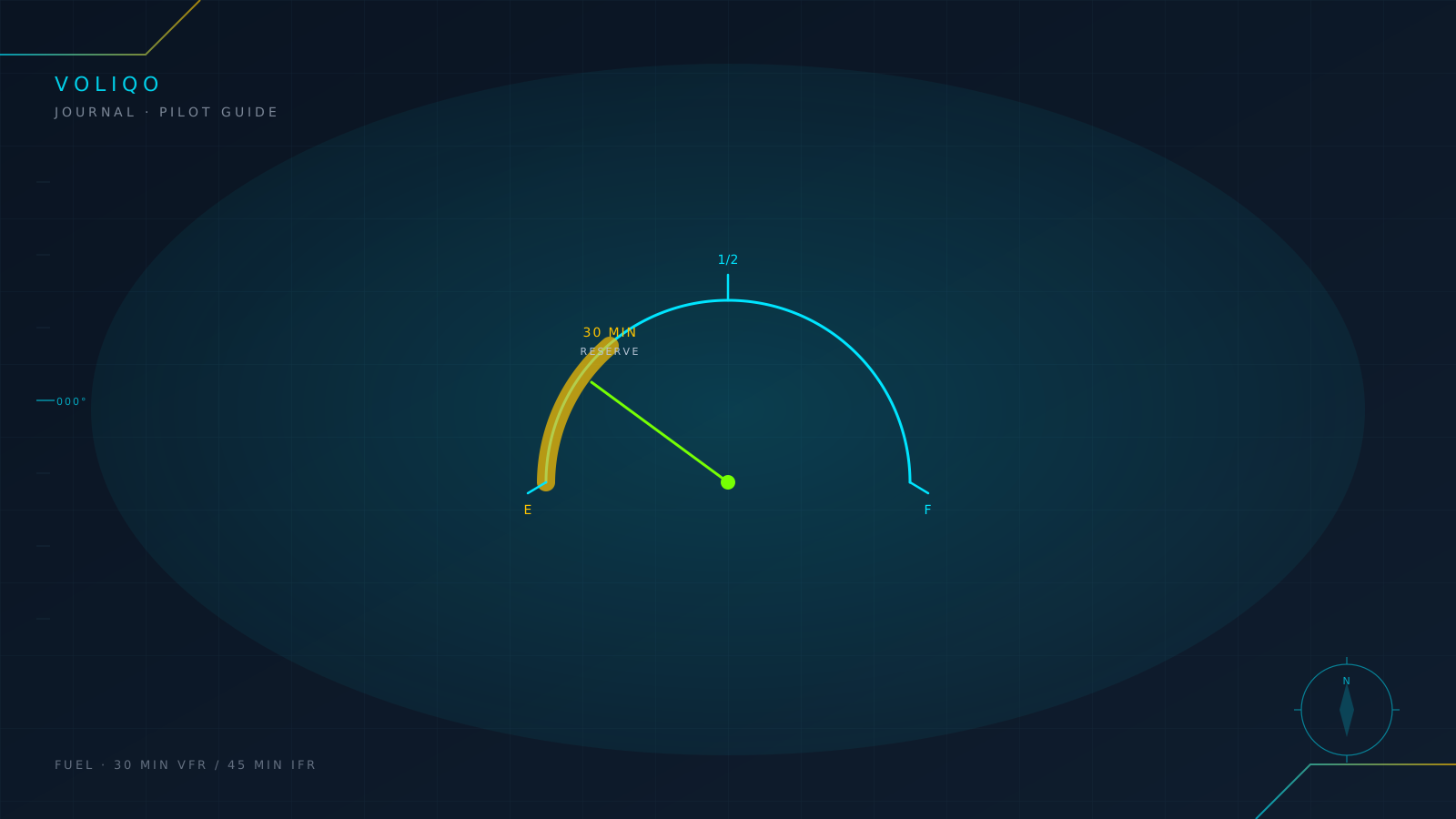
Every pilot learns the 30-minute VFR fuel reserve rule in initial training. Most pilots forget that it's the legal minimum, not the target. The number on your fuel gauge at touchdown should never be 30 minutes — it should be more. The pilots who routinely land with 30 minutes are also the pilots who occasionally land with 5 minutes when something doesn't go to plan. This is the practical guide to fuel reserves that actually keeps you safe.
The rule, decoded
In most jurisdictions, the legal VFR fuel reserve is 30 minutes at cruise consumption. For IFR, it's 45 minutes plus fuel to alternate. The exact wording varies (FAA, EASA, individual national CAAs), but the threshold is universal:
- Day VFR: 30 min reserve at cruise burn
- Night VFR: 45 min reserve in most jurisdictions
- IFR: fuel to destination + fuel to alternate + 45 min reserve at cruise burn
For a Tecnam P92 Echo MkII burning 17 l/h, 30 minutes = 8.5 litres. For a Shark 600 burning 20 l/h at 75% power, 30 minutes = 10 litres. These are tiny amounts of fuel — easy to consume in a single missed approach or holding pattern.
Tank capacity vs usable fuel
The first reality check: tank capacity is not usable fuel. A 90-litre tank doesn't deliver 90 litres of cruise fuel. It delivers:
- Total tank capacity: e.g., 90 l
- Minus unusable fuel: 1–3 l per tank that the fuel pickup can't reach (especially in low-wing aircraft on uncoordinated turns)
- Minus fuel for taxi + climb: typically 3–5 l before reaching cruise altitude
- Minus reserve: 30 min at cruise burn
For the P92 Echo MkII (90 l tank, 17 l/h cruise):
- Unusable: ~2 l → 88 l usable
- Taxi + climb: ~3 l → 85 l for cruise
- Reserve (30 min legal): 8.5 l → 76.5 l available for the actual cruise leg
- Range at 76.5 l × 213 km/h ÷ 17 l/h = ~960 km
Compare that to the brochure number of 1,296 km. The brochure assumes you fly until the tank is dry, which is illegal in any jurisdiction. The realistic max is ~25% lower.
Headwind: the silent fuel killer
A 15 kt headwind on a 200 nm leg adds 30+ minutes of flight time and 8+ litres of fuel burn. If your pre-flight calculation said "we land with exactly 30 min reserve", the headwind eats the reserve.
The discipline:
- Pull METAR + TAF + winds aloft for your route (planner does this automatically)
- Compute groundspeed for your planned cruise altitude with actual winds
- If GS is more than 10% below TAS, plan an extra 10% fuel
- If GS is more than 20% below TAS, replan the route or pick a closer destination
For the Tecnam P2010 TDI on a 700 km cross-country with 15 kt headwind:
- TAS 250 km/h, headwind 28 km/h → GS 222 km/h
- Time at GS: 700 / 222 = 3h 09m
- Time at TAS: 700 / 250 = 2h 48m
- Difference: 21 min = ~7 l extra fuel
- New reserve: 30 min - 21 min = 9 min. Below legal.
Practical answer: add a 1-hour buffer to the published range when planning into wind. If the planner says "feasible with 30 min reserve", you actually want "feasible with 1 hour reserve" before headwind.
The "land with 1 hour" rule
Veteran cross-country pilots have a rule: always land with at least 1 hour of fuel, regardless of legal minimums. The reasoning:
- 1 hour is enough to divert to a real alternate if your destination is closed (weather, runway incident, fuel pump broken)
- 1 hour absorbs unexpected delays (holding for traffic, ATC vectors)
- 1 hour is enough to find a non-towered field and land safely if everything goes wrong
The cost: 30 minutes of fuel per leg. For a 200 nm cross-country, that's ~10 l of extra reserve. For an Tecnam P92 Echo MkII, that's the difference between a 1,296 km leg (zero margin) and a 1,000 km leg (1-hour margin).
For UL/LSA pilots flying day-VFR locally, the 1-hour rule is almost certainly overkill — you're probably never far from a familiar field. For cross-country pilots, especially over water, mountains, or remote areas, it's the floor that prevents the worst outcomes.
Fuel selector discipline
Most low-wing UL/LSA aircraft have left/right tank selectors. The discipline:
- Switch tanks every 30 minutes in straight-and-level cruise to balance fuel
- Always select the fuller tank for take-off and landing (gives unusable-fuel buffer in case of pickup issues)
- Never run a tank dry on purpose even if you're trying to "use it up" — the engine restart on the other tank takes precious seconds
For the Shark 600 with 100 l (50 l × 2), the alternation discipline is critical because the airframe is sensitive to lateral fuel imbalance and the autopilot (if installed) compensates with rudder trim that you might not notice.
Voliqo's reserve % field
In the planner, the Reserve % field controls how much of your fuel capacity is set aside as reserve before computing range. The default is 10%, but the actual meaning is:
- Reserve % = 10 → range computed with 90% of fuel capacity available for cruise
- Reserve % = 15 → range computed with 85% of fuel capacity
- Reserve % = 25 → range computed with 75% of fuel capacity (the "1-hour rule" approximation)
Internally, the planner converts this percentage to litres × cruise burn rate × 60 minutes. The reserve % is multiplied by fuelCapacityLiters to compute reserve litres, then subtracted from usable fuel.
Recommended settings:
- Day VFR local flying, calm wind: 10% (legal minimum-ish)
- Day VFR cross-country, light winds: 15%
- Cross-country with weather risk: 20%
- Over water, mountains, or remote areas: 25%
- Night VFR: 25%
- IFR (when supported): 30%
When the math doesn't work
Sometimes you do all the math and the answer is "not enough fuel". Three options:
- Pick a closer destination (split the trip into two legs)
- Pick a different aircraft (a Tecnam P-Mentor at 9h30 endurance gives more margin than a P92 Echo MkII at 5h)
- Wait for better weather (fuel calculations with tailwinds work; wait for the wind to shift)
What you should NOT do: run the tank dry, accept "5 minutes legal" reserves, or skip the reserve entirely "just this once". The pilots who do this routinely are the pilots who eventually run out of fuel on final.
Fuel exhaustion vs fuel starvation
A subtle distinction worth knowing:
- Fuel exhaustion: tanks empty. You ran out.
- Fuel starvation: fuel exists in tanks, but isn't reaching the engine. Selector wrong, fuel pump failed, line blocked.
Fuel starvation accidents typically have fuel-on-board > 30 min when the pilot lands off-airport. The tanks weren't empty; the fuel just wasn't getting to the engine. Pre-flight inspection of the fuel selector, electric pump (if installed), and lines is the prevention.
Bottom line
The 30-minute VFR fuel reserve is the legal floor. Real cross-country pilots aim for 1 hour. Headwinds eat reserves invisibly. Tank capacity isn't usable fuel; usable fuel isn't endurance fuel.
For UL pilots flying day-VFR, fuel anxiety should be minimal — you're rarely flying anywhere that's not within 30 nm of a fuel pump. For cross-country pilots, fuel discipline is the difference between flying for 30 years uneventfully and the unwanted phone call from the side of a field.
Plan with 20% margin minimum. Land with at least 1 hour of fuel. Never trust the brochure range.