Great circle vs rhumb line: which route to fly?
Take any two airports on a map and ask 'what's the shortest path between them?'. The intuitive answer — draw a straight line — is wrong almost everywhere except over short distances. The Earth is round; flat maps lie.
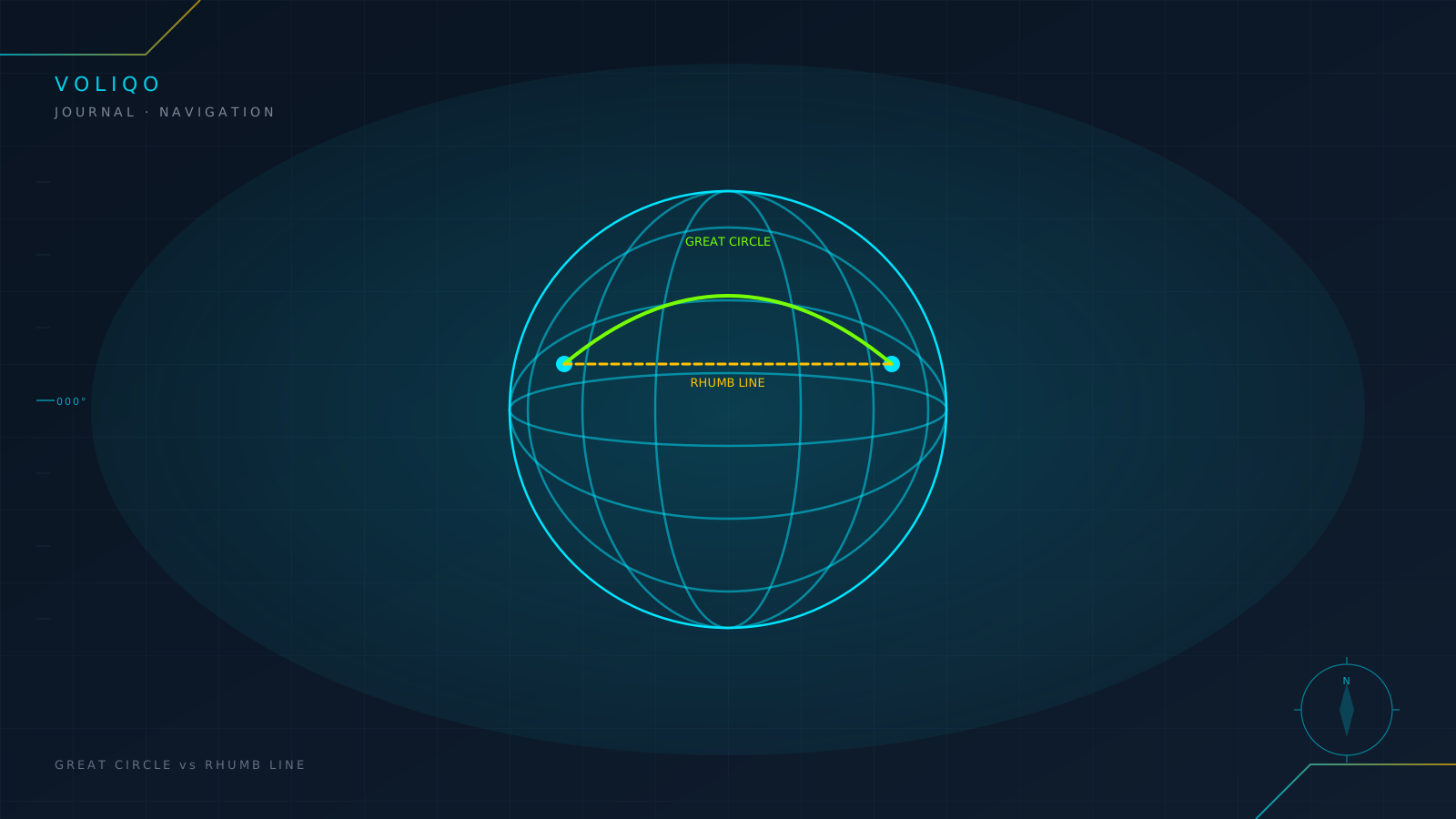
Take any two airports on a map and ask "what's the shortest path between them?". The intuitive answer — draw a straight line on a paper chart — is wrong almost everywhere except over very short distances. The Earth is round; flat maps lie. The two ways to fly between two points are the great circle (the actual shortest path on a sphere) and the rhumb line (a constant-heading line that's only straight on certain map projections). For most flying, the difference doesn't matter. For some flying, it matters a lot. Here's when.
The geometry, in 60 seconds
The Earth is approximately a sphere. The shortest distance between two points on a sphere is along the great circle — the arc of a circle whose center coincides with the center of the sphere. On a globe, a great circle looks straight; on a flat Mercator map, it appears curved (curving toward the poles).
A rhumb line (or "loxodrome") is a path that crosses every meridian at the same angle. On a globe, a rhumb line spirals toward the poles; on a Mercator map, it's a straight line. Following a rhumb line means flying with a constant compass heading (relative to true north).
The differences:
- Distance: great circle = shortest. Rhumb line is longer.
- Heading: great circle requires constant heading changes. Rhumb line is constant heading.
- Map appearance: on Mercator (the standard chart), great circle = curved, rhumb line = straight.
When the difference matters
For short legs in mid-latitudes, the difference is negligible. A 200 nm leg from Pisa (LIRP) to Bergamo (LIME) at 43–45°N: rhumb line ≈ 200 nm, great circle ≈ 199.8 nm. You can't measure the difference.
For long east-west legs at high latitudes, the difference is significant. A 3,000 nm transatlantic from London to New York at 50–55°N: rhumb line ≈ 3,000 nm, great circle ≈ 2,800 nm. 200 nm shorter — meaningful for fuel and timing.
Rules of thumb:
- Leg < 500 nm at any latitude: difference < 1 nm. Fly the rhumb line for simplicity.
- Leg 500–2,000 nm at mid-latitudes: difference 1–10 nm. Worth using great circle.
- Leg 2,000+ nm at high latitudes: difference > 50 nm. Always use great circle.
- Any leg crossing the dateline or going polar: great circle is the only sensible answer.
For UL/LSA flying with typical 200–700 km legs in central latitudes, the difference is always negligible. The geometry conversation matters more for jet ferry pilots and long-haul commercial.
Why GPS/FMS uses great circles
Modern GPS and FMS systems compute great-circle navigation by default. When you enter a direct-to waypoint, the system:
- Computes the great-circle bearing from your current position to the waypoint
- Updates that bearing continuously as you fly (the great-circle bearing changes constantly)
- Displays the current bearing on the HSI
This means you're flying a great circle, but your actual heading on the compass is changing as you fly. On a 2,000 nm leg, you might depart on a 270° heading and arrive on a 240° heading — both correct great-circle headings at their respective points along the route.
If you're using a paper chart with a straight line drawn between departure and destination, that line is a rhumb line on Mercator. Following it gives you a longer flight than the GPS great circle.
Magnetic vs true vs grid heading
A complication: the great-circle bearing your GPS shows is in true degrees (relative to true north). Your DG/HSI shows magnetic degrees (relative to magnetic north).
The variation between true and magnetic depends on your location. In central Italy, variation is roughly +3°E (so magnetic = true + 3°). In northern Scandinavia, variation can be +12°E or more.
For polar flying (above 70° latitude), variation becomes erratic — that's why long-haul polar routes use grid navigation (a third reference frame based on the longitude meridians at one specific point).
For UL pilots flying in mid-latitudes, the magnetic-heading method works fine. Just remember:
- GPS computes true
- DG/HSI shows magnetic
- The difference is the variation, which the GPS usually shows on screen
Voliqo's planner uses great circles
In Voliqo's planner, all leg geometry is computed using great circles. When you draw a route from departure to arrival on the map, the polyline is the great-circle path between the two points. For multi-leg tours, each segment is a separate great circle; the planner doesn't try to optimize across legs.
This means:
- The distance shown is the great-circle distance (= shortest)
- The polyline on the map curves slightly on Mercator projection (more visible on long legs)
- Range circles around departure use great-circle distance (so the boundary is a "circle" on the globe, even though it doesn't look perfectly circular on a 2D map)
For UL legs typically under 500 km, the polyline looks identical to a straight line on the map. For longer legs (some Tecnam P2010 TDI cross-country flights at 1300 km), the curvature becomes visible — a useful visual cue that you're flying a real great-circle path.
Filing flight plans: rhumb line in some jurisdictions
Some flight plan systems (especially older ones, or specific national variations) request constant-heading legs — i.e., rhumb lines. This is a holdover from the era when navigation was done by compass and paper charts, and pilots needed simple "fly heading X for time Y" instructions.
Modern flight plan systems (ICAO Doc 4444 format) accept great-circle waypoint navigation natively. The ICAO format specifies waypoints; how you connect them is up to you (and your GPS/FMS, which uses great circles).
For UL flying with VFR flight plans, this is rarely an issue — you file a route and fly it. For commercial IFR with airway routings, the airways themselves are sequences of great-circle segments between fixes, and the question doesn't really come up.
When to use rhumb line on purpose
Two scenarios:
- Compass-only navigation: if you're flying without GPS (training scenario, equipment failure), holding a constant compass heading along a rhumb line is mentally simpler than continuously updating heading along a great circle. For short legs the difference is negligible.
- Search and rescue or surveillance: when you want to fly a precise grid pattern over an area, rhumb lines are useful because constant-heading tracks are reproducible.
For everything else — including normal cross-country flying — let the GPS compute great circles and just fly the magenta line.
How to compute distance manually
If you ever need to compute great-circle distance between two airports without a GPS, the formula is the haversine:
a = sin²(Δφ/2) + cos(φ1) × cos(φ2) × sin²(Δλ/2)
c = 2 × atan2(√a, √(1−a))
d = R × c
Where φ is latitude, λ is longitude, both in radians, and R is the Earth's radius (6,371 km or 3,440 nm).
For a quick check, the rough rule: 1° of latitude ≈ 60 nm, regardless of longitude. 1° of longitude ≈ 60 × cos(latitude) nm. At 45°N, 1° of longitude ≈ 42 nm.
Bottom line
For UL/LSA pilots flying typical legs of 100–700 km in mid-latitudes, the great circle vs rhumb line distinction is academic — the difference is < 1 nm. Just fly the magenta line on your GPS and don't think about it.
For long-haul cross-country pilots, the difference becomes meaningful at 1,000+ nm in mid-latitudes and at any distance in high latitudes. Modern GPS handles great-circle navigation transparently; the era of pilots manually plotting great circles on paper charts is over.
Voliqo's planner computes great circles by default, so the distances you see in the route summary are accurate. For visual comparison with rhumb-line distances, multiply by ~1.0–1.05 depending on latitude and route orientation; the difference is usually inside the rounding error of your fuel calculation.