Magnetic vs true heading: the variation trap most pilots forget
You're flying east. Your GPS says you're tracking 090° true. Your DG says you're heading 087° magnetic. Both are correct, both are different, and the 3° discrepancy on a 300 nm leg puts you 15 nm off course at the destination.
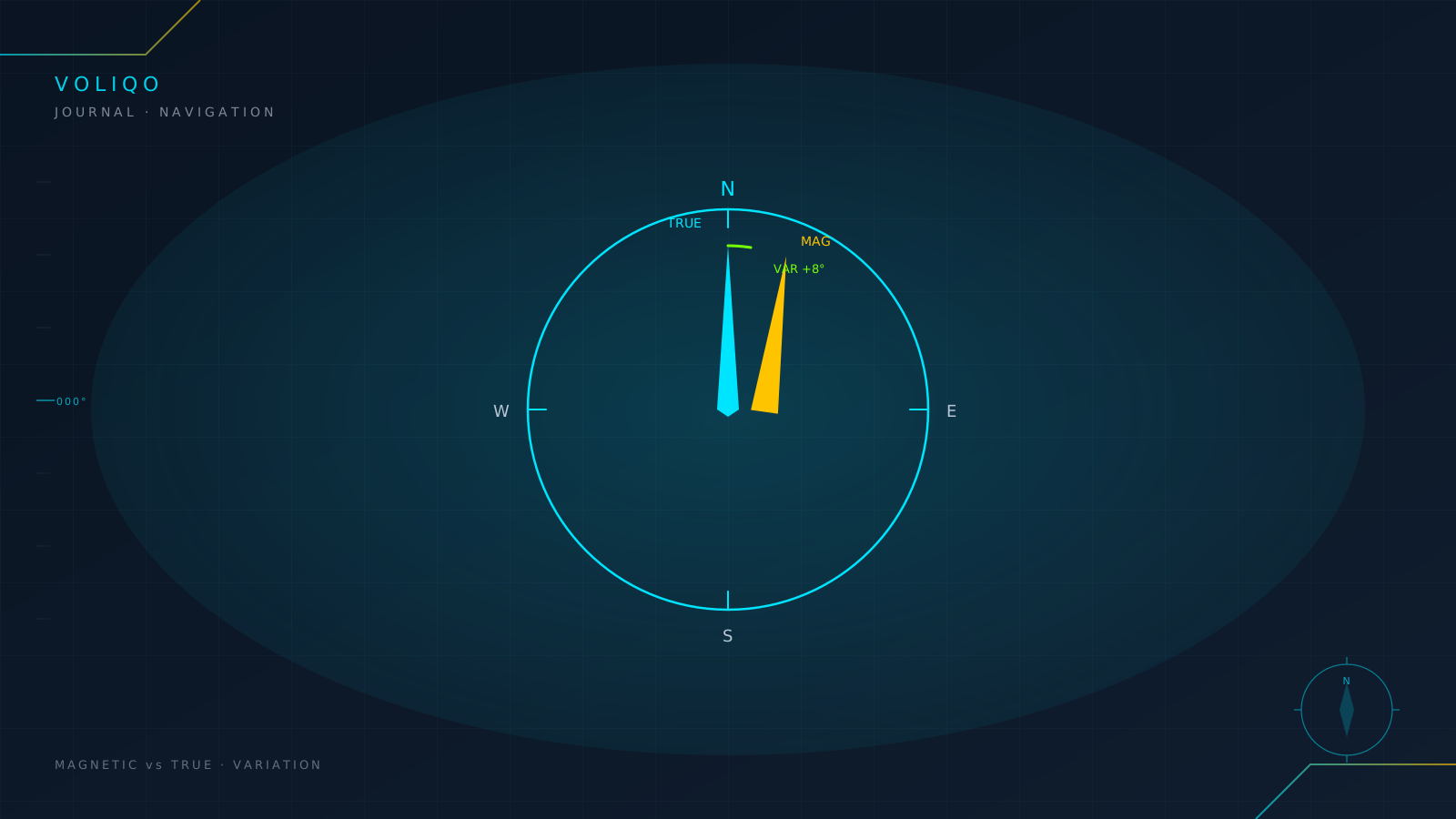
You're flying east. Your GPS says you're tracking 090° true. Your DG/HSI says you're heading 087° magnetic. Both are correct, both are different, and the 3° discrepancy on a 300 nm leg puts you 15 nm off course at the destination. Magnetic vs true heading is one of those concepts that every student pilot learns and most pilots stop thinking about — until they end up at the wrong airfield wondering what happened. This is the practical guide.
Two reference frames, one airplane
Aviation uses two different "north" references at the same time:
- True north: the geographic North Pole (the Earth's spin axis). What maps and GPS use.
- Magnetic north: the direction a magnetic compass points, which is not the same place as true north — it's currently in the Canadian Arctic and drifting toward Siberia at ~50 km/year.
The angular difference between true north and magnetic north at any specific location is called magnetic variation (or "declination" in geophysics).
Your DG/HSI measures heading relative to magnetic north (because it's calibrated against a magnetic compass on installation). Your GPS computes track relative to true north (because it's reading from satellite-derived geographic coordinates).
The two readings differ by exactly the local magnetic variation.
Variation across the world
Variation values you'll encounter:
- Lisbon, Portugal: −2° (variation west, magnetic = true + 2°)
- Rome, Italy: +3° (variation east, magnetic = true − 3°)
- Berlin, Germany: +5°
- Helsinki, Finland: +14°
- Reykjavik, Iceland: −10°
- New York, USA: −13°
- Los Angeles, USA: +12°
- Tokyo, Japan: −7°
- Sydney, Australia: +13°
The variation changes slowly — about 0.1° per year in most places. Aviation charts publish "isogonic lines" (lines of equal variation) that get updated every few years.
The mnemonics
The classic memory aids:
- "East is least, west is best" — east variation: subtract from true to get magnetic. West variation: add.
- "Variation east, magnetic least" / "variation west, magnetic best" — same idea, different phrasing.
Practical math:
- Variation east 5° → magnetic = true − 5°. If your GPS says track 090° true, your DG should read 085° magnetic.
- Variation west 5° → magnetic = true + 5°. If your GPS says track 090° true, your DG should read 095° magnetic.
The 4° error trap
A common scenario: a pilot learns to fly in southern Europe (variation +3°). Years later, they fly a northbound cross-country to northern Europe. They cross from variation +3° to variation +12°. The difference accumulates over 1,000 km.
For a single leg of 300 nm at +3° variation, the pilot's DG-based heading will be 3° off the GPS true track. Over 300 nm at 3° error: lateral drift = 300 × tan(3°) ≈ 15 nm.
For a transatlantic flight crossing variation from +5° to −15° (a 20° swing), the cumulative drift over 3,000 nm without correction would be tens of nautical miles. This is why long-haul pilots track GPS course continuously and not just the DG.
What modern GPS does
Modern GPS / FMS systems:
- Compute true track from satellite positions
- Look up the local magnetic variation from a built-in NOAA WMM (World Magnetic Model) database
- Display BOTH true and magnetic to the pilot, depending on configuration
- Compute the bearing to a waypoint as either true or magnetic, again depending on config
For UL/LSA flying with Garmin or Dynon avionics, the panel display defaults to magnetic for compatibility with the airframe's installed DG/compass. Switching to true (sometimes a soft-key option) is useful for cross-checking but isn't the day-to-day reference.
Why aviation still uses magnetic
A reasonable question: why not just standardize on true everywhere?
Because the DG (directional gyro) and magnetic compass — installed in every airframe — measure magnetic. Switching the GPS to true would mean the pilot has to mentally compensate every time they cross-check the heading. That's an error vector aviation chose not to introduce.
Some IFR procedures and FMS waypoint definitions internally use true bearings (especially in polar regions where magnetic gets erratic), but the cockpit displays show magnetic to the pilot. This is also why airline pilots talk about "270 the heading bug" — that's magnetic, even though the FMS computed it from true geography.
Voliqo's planner
In the planner, the route information panel shows both:
- Distance: great-circle in km and nm
- Track: in TRUE bearing (matches GPS)
- Magnetic track: applied variation at the midpoint of the leg
For a leg from Lisbon (variation −2°) to Rome (variation +3°), the planner computes track at each end and shows the midpoint variation. This isn't a magic — it's a lookup in the WMM database. The display gives you the heading you'd actually fly with your DG/HSI.
For typical UL/LSA legs of 200–700 km, the magnetic vs true difference is small (variation changes < 1° over those distances in mid-latitudes). For long cross-countries, the variation midpoint estimate is good enough; for very long legs, plan to refresh the heading every 100 nm.
Common pilot errors
Three patterns we see:
- Reading magnetic from the chart, flying GPS true track: chart says 270° magnetic to destination, GPS shows 273° track — the pilot trusts the chart, drifts north of course
- Forgetting variation when filing flight plan: flight plan filed with magnetic bearings, ATC clearance issued in true bearings (depends on jurisdiction) — confusion in clearance
- Crossing isogonic lines without re-checking: a 5-hour flight that crosses 10° of variation can put you well off course if you only set the initial heading and don't update
The fix for all three: trust the GPS magenta line, cross-check the DG against the GPS magnetic display, and update the heading whenever they disagree.
In polar regions
Above ~70° latitude, the lines of magnetic variation become very tight together — small position changes produce large variation changes. In some places near the magnetic pole itself, a magnetic compass can become essentially unusable.
Polar route operations use grid navigation: a third reference frame oriented to a chosen meridian, which stays stable across the polar region. Long-haul pilots flying transpolar routes get specific training on grid heading.
For UL/LSA pilots not flying above 65° latitude, this is a non-issue. The variation lookup tables stay accurate.
Bottom line
Magnetic vs true heading is one of the most common sources of position error in aviation, and one of the easiest to fix. Three rules:
- Trust the GPS magenta line for navigation
- Cross-check the DG against the GPS magnetic display every 10 minutes
- Update heading at midpoint on legs longer than 200 nm in regions with significant variation gradient
The 4° variation error on a 200 nm leg puts you 14 nm off course at the destination. Over a 5-hour cross-country, that's the difference between landing where you planned and landing somewhere with a "wait, where am I?" moment. The cost of getting it right: a few seconds of cross-checking. The cost of getting it wrong: an unscheduled diversion, possibly into airspace you didn't plan for.
Voliqo's planner does the variation math for you in advance. Use it. The era of pilots tracking magnetic variation manually with a paper chart and a piece of string is mostly over — but the variation hasn't gone away just because the math has.