PoH numbers vs Pilot's Handbook: which to trust when they disagree
The PoH gives you the idealized maximum under flight-test conditions. The experienced pilot gives you the typical operational reality. The gap between these is where pilots learn to plan flights that survive contact with the real world.
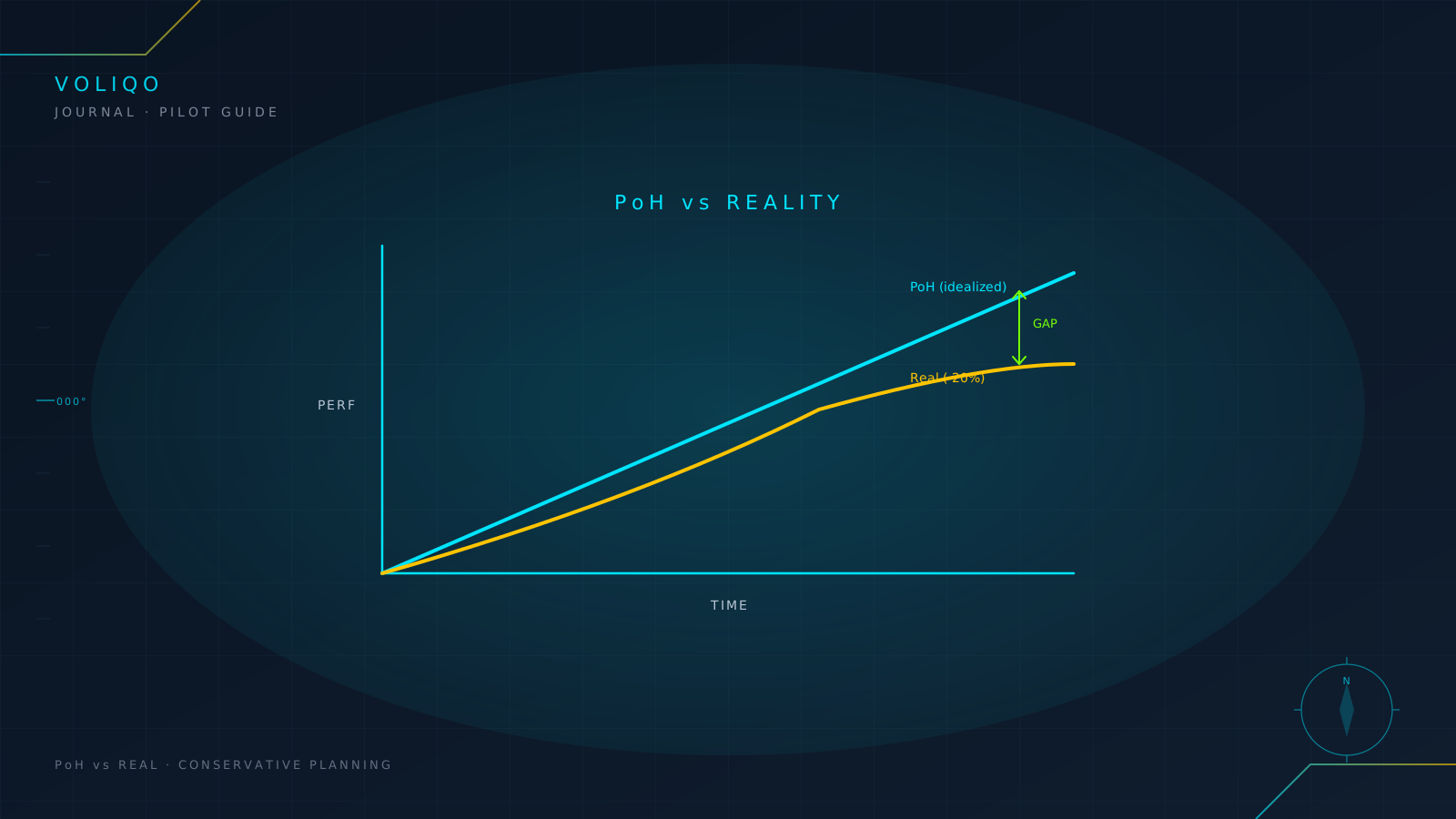
Open the Pilot's Operating Handbook (PoH) for a Tecnam P92 Echo MkII and you'll see climb rate 1,000 ft/min at MTOW. Talk to a pilot who's flown 200 hours in one and they'll say "plan for 800". Both are right — at different things. The PoH gives you the idealized maximum under flight-test conditions; the experienced pilot gives you the typical operational reality. The gap between these two numbers is where pilots learn to plan flights that survive contact with the real world. This is the practical guide.
What's actually in the PoH
Manufacturers' published performance numbers come from flight-test data conducted under specific conditions:
- Standard atmosphere: 15°C at sea level, ISA throughout the climb
- MTOW or below: tested at maximum take-off weight, but with controlled CG
- Brand-new airframe: zero airframe time, fresh engine, smooth wings, clean leading edges
- Test pilot technique: optimized speed, optimized lean, optimized prop pitch
- No wind: still air or precisely measured calibration winds
- Calibrated instruments: factory-fresh ASI, altimeter, RPM gauges
These conditions don't accumulate by accident. Manufacturers want the published numbers to be high — they sell airplanes. The numbers are technically true, but they describe an idealized scenario that real pilots almost never see.
What you actually get in the field
Real-world performance degradation, accumulating from multiple sources:
- Airframe age: 10 years of flying = nicks, slight skin distortions, paint roughness, plus drag from fairings that don't quite fit anymore. Cost: ~3% cruise speed.
- Engine age: 1,500 of 2,000 TBO hours = down ~5% from new on max power. Plus inevitable wear on the prop's leading edge.
- Pilot technique: most pilots aren't optimizing every parameter every minute. Cruise speed off optimal by 2–4%.
- Weight at full passengers + fuel: 600 kg published implies a specific weight & balance; in reality you might be 595 kg (close to MTOW) with CG slightly aft.
- Atmosphere: rarely standard. Even on a "nice" day, OAT might be +3° or +5° from ISA.
- Wind: rarely zero on the ground; rarely exactly the planned value at altitude.
Stack all these and the published 1,000 ft/min becomes 800. The published 213 km/h becomes 200–205. The published range becomes 90% of brochure.
The conservative-number method
Veteran cross-country pilots use a simple rule for translating PoH numbers into planning numbers:
| PoH says | Plan with | |---|---| | Climb rate | -20% (so 1,000 fpm → 800 fpm) | | Cruise speed | -5% (so 213 km/h → 202 km/h) | | Range | -10% (so 1,296 km → 1,166 km) | | Take-off roll | +25% (so 250 m → 312 m) | | Landing roll | +20% (so 200 m → 240 m) | | Service ceiling | -1,500 ft (so 14,000 → 12,500) |
These derating factors are conservative enough to absorb most real-world variability without being so paranoid that the airplane becomes useless on paper. After 200 hours in the same airframe, you'll calibrate them to your specific aircraft.
Why the published numbers can mislead pilots
Three concrete failure modes when pilots trust the PoH directly:
1. Take-off margin
PoH take-off roll: 250 m. Available runway: 300 m. Pilot says "great, plenty of margin".
Reality: 250 m × 1.25 = 312 m at MTOW on a normal day. Available 300 m is now too short. The published number was at sea level, 15°C, no wind, brand-new engine, fresh tires, hard runway. On a 25°C grass strip with a slight upslope, the take-off roll is 350 m.
Pilots who plan with PoH numbers and short fields end up doing partial-fuel take-offs to lighten the load — or worse, attempting take-offs that abort on the runway end.
2. Range planning
PoH range: 1,296 km with 30-min reserve. Planned leg: 1,150 km. Pilot says "fine, 145 km of margin".
Reality: real range with degraded engine + headwind component + non-optimal cruise = 1,166 km. Available margin is now 16 km. A 15 kt headwind for the last hour shrinks margin to negative.
Pilots who plan with PoH numbers and long legs occasionally end up landing with 5 minutes of fuel.
3. Climb-out planning
PoH climb to 8,000 ft: 8 minutes (1,000 fpm × 8). Pilot says "I'll cross the pass with plenty of altitude".
Reality: real climb at 800 fpm + 15 kt headwind reducing GS = 12 minutes. You arrive at the pass crossing point 600 ft lower than planned, with 12 nm less terrain margin.
For Alpine cross-country flights, this single error has been responsible for many CFIT (controlled flight into terrain) incidents. The mountain doesn't care about the PoH.
The pilot's "real handbook"
After 50–100 hours in a specific airframe, pilots develop their own performance numbers. These are usually:
- Slightly more pessimistic than the conservative-number method
- Calibrated to the specific airframe (your N123AB might be 2% slower than the next P92)
- Calibrated to your typical weight + CG configuration (e.g., usually 540 kg, not MTOW)
- Calibrated to your usual altitudes and atmospheres
This "personal POH" lives in the pilot's head and is the reason ATPL captains can give precise ETAs from rote calculation. UL pilots can develop the same skill in 30–50 hours of careful note-taking.
What Voliqo does
Voliqo's planner uses the published catalog values for cruise speed, range, fuel burn — i.e., PoH numbers. The planner doesn't auto-apply conservative derating because:
- The derating factor varies by aircraft, by pilot, by use pattern
- A typical 10–20% derating would systematically under-promise range and discourage longer flights
- The pilot's job is to apply derating based on personal calibration
The reserve % field in the planner is the lever you have to apply conservative buffer:
- 10% reserve: matches the legal floor, assumes PoH numbers are achievable
- 15% reserve: buffer for typical degradation
- 20% reserve: buffer for headwind + degradation + worn engine
- 25% reserve: cross-country with weather risk + no familiar destination
For a long cross-country in a Tecnam P2010 TDI where margin matters, set 20% reserve in the planner and don't second-guess it.
When the PoH is conservative on purpose
A nuance: some PoH numbers are deliberately conservative — especially for older airframes whose certification process emphasized safety margins. A 1985 Cessna 172 PoH lists climb rate of 770 ft/min; in practice, with a clean airframe and engine, you'll see 850 ft/min. The PoH was already derated.
Modern UL/LSA airframes (Tecnam, Shark, Risen) tend to publish optimistic numbers because the certification process for the 600 kg category is industry-self-administered (UL) or consensus-standard (LSA), not full type-certification. Buyer-be-aware.
The "first 100 hours" calibration
When you buy or rent a new airframe, plan the first 100 hours conservatively:
- Use the conservative-number method for everything
- Track real numbers in a logbook (climb time to 5,000 ft, cruise speed at 75% leaned, fuel burn per hour)
- After 50 hours, you'll have enough samples to build a personal performance chart
- After 100 hours, you'll know whether your specific airframe is closer to PoH or closer to the derated numbers
This calibration is the difference between "trust the manufacturer" and "trust your own data". The latter is what makes pilots resilient to bad days.
Bottom line
The PoH is true at the moment of certification, in the hands of a test pilot, in standard atmosphere, in a brand-new airframe. Real flight rarely matches all those conditions simultaneously.
The conservative-number method (-20% climb, -5% cruise, -10% range, +25% take-off) is your first approximation until you have enough hours in a specific airframe to build a personal performance chart. The Voliqo planner defaults to PoH values; you apply the derating via reserve % and conservative cruise estimates.
The pilots who get caught are the ones who trust the PoH for planning and the field for everything else. The pilots who fly long careers are the ones who trust their own logbook.