Porto Aviation Risen: the ultralight that flies like a turboprop
The Risen is the airframe that broke the assumption that ultralight meant compromised. Italian carbon, retractable gear, four engine families, twelve catalog configurations — and a 600 kg airplane that cruises at 395 km/h.
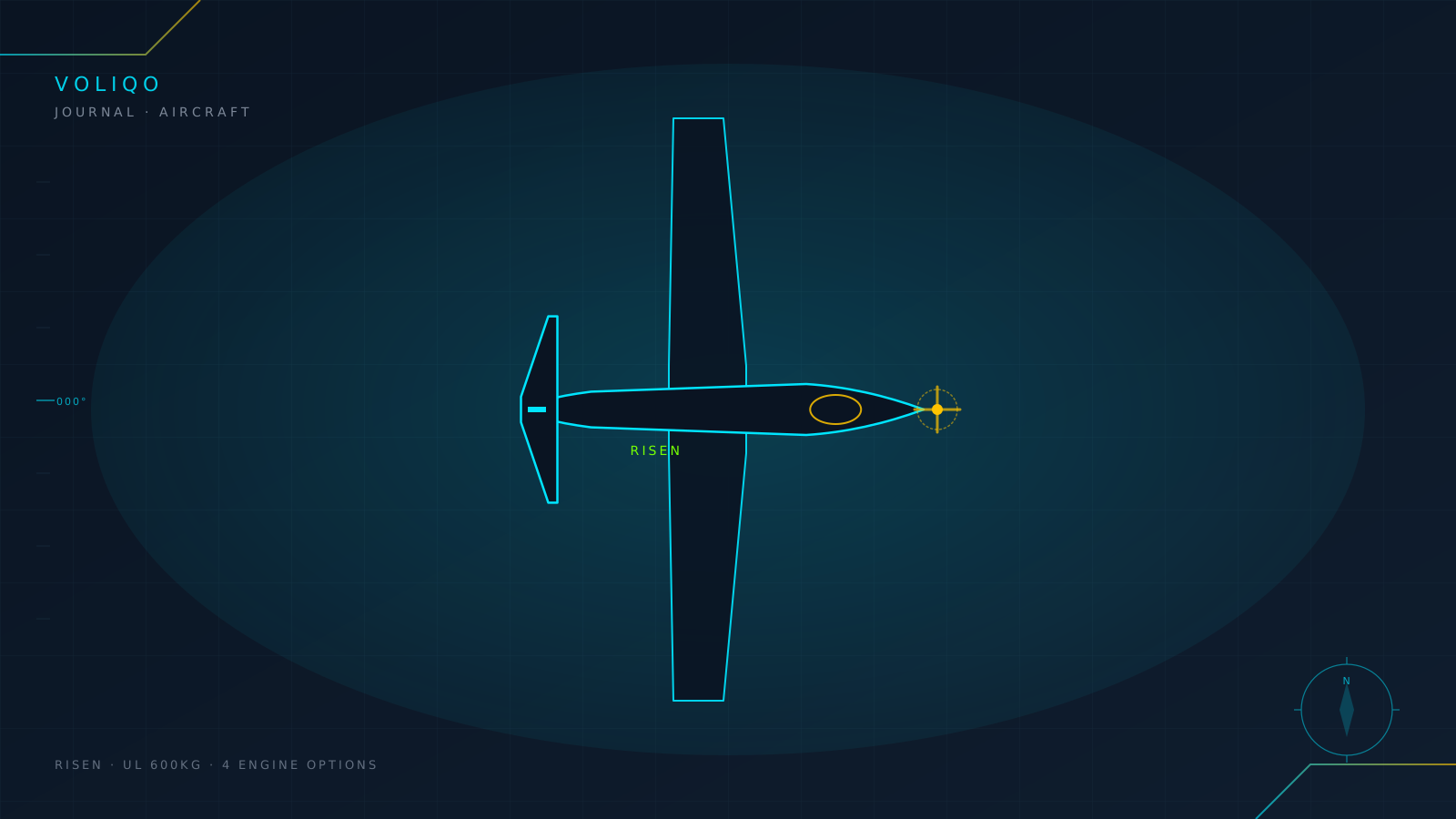
Walk a Risen up to a hangar full of conventional Cessnas and the people standing around will pause mid-conversation. The shape is wrong for an ultralight: tapered carbon fuselage, retractable tricycle gear, a canopy that wraps the cockpit like a fighter, wings that look long-range. Then someone tells them it weighs 600 kg and burns 8 l/h on a long cruise leg, and the conversation gets quiet. The Risen is the airframe that broke the assumption that ultralight meant "compromised". It also happens to be Italian.
The airframe in numbers
The Risen is a single airframe with four engine families and twelve catalog configurations in our database. The shared envelope:
- MTOW 600 kg base, 625 kg in the SV 916iS variant
- VNE 340 km/h IAS (450 km/h TAS in the SV)
- Stall 65 km/h with full flaps (35 kt) — same as a Cessna 152
- Service ceiling 14,000 ft NA, up to 6,000 m (FL200) on the 916iS turbo with O₂
- Useful load 280–285 kg
- Take-off ground roll ~150 m (paved, ISA, sea level)
What changes between configurations is what hangs off the firewall and how aggressive you let the prop spin. Hour by hour, the Risen is whatever its engine permits.
The four engines
In the catalog:
- Rotax 912iS (100 hp FI) — the entry. Three Risen 912iS configurations: Max Range (2400 km @ 190 km/h), 75% power (1990 km @ 295 km/h), Max Continuous (1460 km @ 325 km/h). The same airframe, three throttle profiles.
- Rotax 914 Turbo (~115 hp) — the bridge. Adds boost capability for FL080–FL120 cruise. Range 1150–1580 km depending on mode. Out of fashion now that 915/916 exist, but plenty of used examples flying.
- Rotax 915iS Turbo (141 hp) — the popular middle. FADEC monoleva, full sea-level boost up to ~15,000 ft, 8 m/s climb. Range 820–1530 km depending on mode.
- Rotax 916iS Turbo (160 hp) — the headline. FL200 cruise capability with O₂, climb up to 11 m/s, and the Risen SV 916iS Max Range configuration that hits 2700 km on 120 l of fuel.
The 916iS Max Range number is the one that sells the airplane. 2700 km, with a 30-minute reserve, on 8.5 l/h cruise burn at FL090. That's a non-stop Sicily–Stockholm if the winds cooperate.
What the retractable gear buys
Most ultralights save weight by skipping retractable gear. Porto Aviation didn't. The Risen's main gear retracts into the wing roots, the nose gear into the lower fuselage. Result:
- About 15–20 km/h cruise advantage over an equivalent fixed-gear airframe at the same power
- Lower drag at altitude — the 916iS variant cruises at 395 km/h at FL180 because the airframe is genuinely slick
- Heavier and more complex than a fixed-gear UL — Porto's hydraulic system is reliable but it's another set of pre-flight checks and another consumable
- A retraction failure means a higher-energy belly landing — pilots transitioning into one should do gear-up landing scenarios in the simulator before solo
For a pilot who does mostly cross-country, retractable gear is a buy. For a pilot who flies short legs and pattern work, it's overkill.
The Lecco DNA
Porto Aviation Group is based in Lecco, on the southern shore of Lake Como. The factory sits with the Italian Alps as the backyard — pilots who design ultralights against that scenery have specific feelings about climb rate, altitude capability, and turbocharging. You can read it in the airframe: the 916iS variant exists because someone at Porto wanted to fly over the Alps to Switzerland on weekends without going around through Brennero.
The carbon fuselage is built in-house. Composite layup is the company's identity — they make racing yachts adjacent to making airplanes, and the same engineering team that lays up the Risen also lays up offshore racing hulls. The seam tolerances are racing-yacht tolerances. That's why the airframe weighs 320 kg empty when a metal-airframe equivalent would weigh 380.
Who flies one
Three buyer profiles we see:
- The pre-IR private pilot — has the PPL, wants to fly real cross-country, doesn't want to wait for a CS-23 type-certified airplane. Picks the 915iS or 916iS Turbo for the altitude capability.
- The retired airline captain — flew turboprops or jets the whole career, downsizing to UL. Wants something that handles like a real airplane. The Risen's retractable gear and slick aerodynamics feel familiar.
- The cross-country tourer — flies 150–300 hours a year, uses the airplane for actual transport between two homes or to visit family abroad. Picks the 916iS Max Range configuration.
What we DON'T see: students and renters. The Risen isn't a trainer — the seating is side-by-side but the systems are too complex (retractable gear, FADEC, boost discipline on the turbo variants) for early PPL work. It's a second airplane, not a first.
What it costs to operate
The 916iS variant is the most expensive Risen and the most representative for a comparison. At 100 hours/year:
- Hourly fuel: 8.5 l × €2.40 = €20/h at ECO, 26 l × €2.40 = €62/h at 75% power, 42 l × €2.40 = €100/h at max continuous
- Engine reserve: 916iS TBO 2,000 h, overhaul ~€25,000 → €13/h
- Hydraulic gear maintenance: ~€500/year amortized
- Insurance: variable; expect 1.2–1.8% of hull value per year
- Hangar: depends entirely on location (€200–800/month is the typical range)
Capex matters: a new Risen 916iS lists at €280,000+ outfitted. A used 912iS variant from 2017–2019 is in the €130,000–€160,000 range. The depreciation curve flattens after year 5 because Porto's airframes hold their value — composite construction doesn't suffer from corrosion the way metal airframes do, and the specific model year matters less than overall hours and avionics generation.
Planning a Risen flight
In Voliqo's planner, pick the Risen variant that matches your engine and your power profile. The Risen catalog entries have dramatically different range numbers depending on power setting — be honest about which mode you actually fly in. A pilot who selects the SV 916iS Max Range entry but actually cruises at 75% will run out of fuel about 1000 km before the planner predicts.
Specifically, the three SV 916iS modes in the catalog are independent rows: Max Range, 75% power, Max Continuous. Pick the one matching your operational reality, not the brochure ideal.
Bottom line
The Risen is a paradox airplane: it weighs the same as a Cessna 152 trainer but flies the same speed as a Mooney M20. The mathematics that makes that possible are mostly the carbon fuselage, the retractable gear, and the option of bolting a 160 hp turbo on the front. None of those are free — capex is high, complexity is real, and the airframe rewards experienced pilots more than it forgives beginners.
If you're shopping in the UL/LSA bracket and you actually need the capability — long legs, high altitude, terrain-crossing — the Risen is the airplane that will keep showing up on your shortlist until you fly one and realise the spec sheet wasn't lying.