Shark 600 vs Shark 600T: which Rotax fits your mission?
The Slovakian Shark is one of those airframes that punches well above its 600 kg weight class. Naturally-aspirated 912 ULS or turbocharged EP 914Ti — same airframe, very different mission profiles.
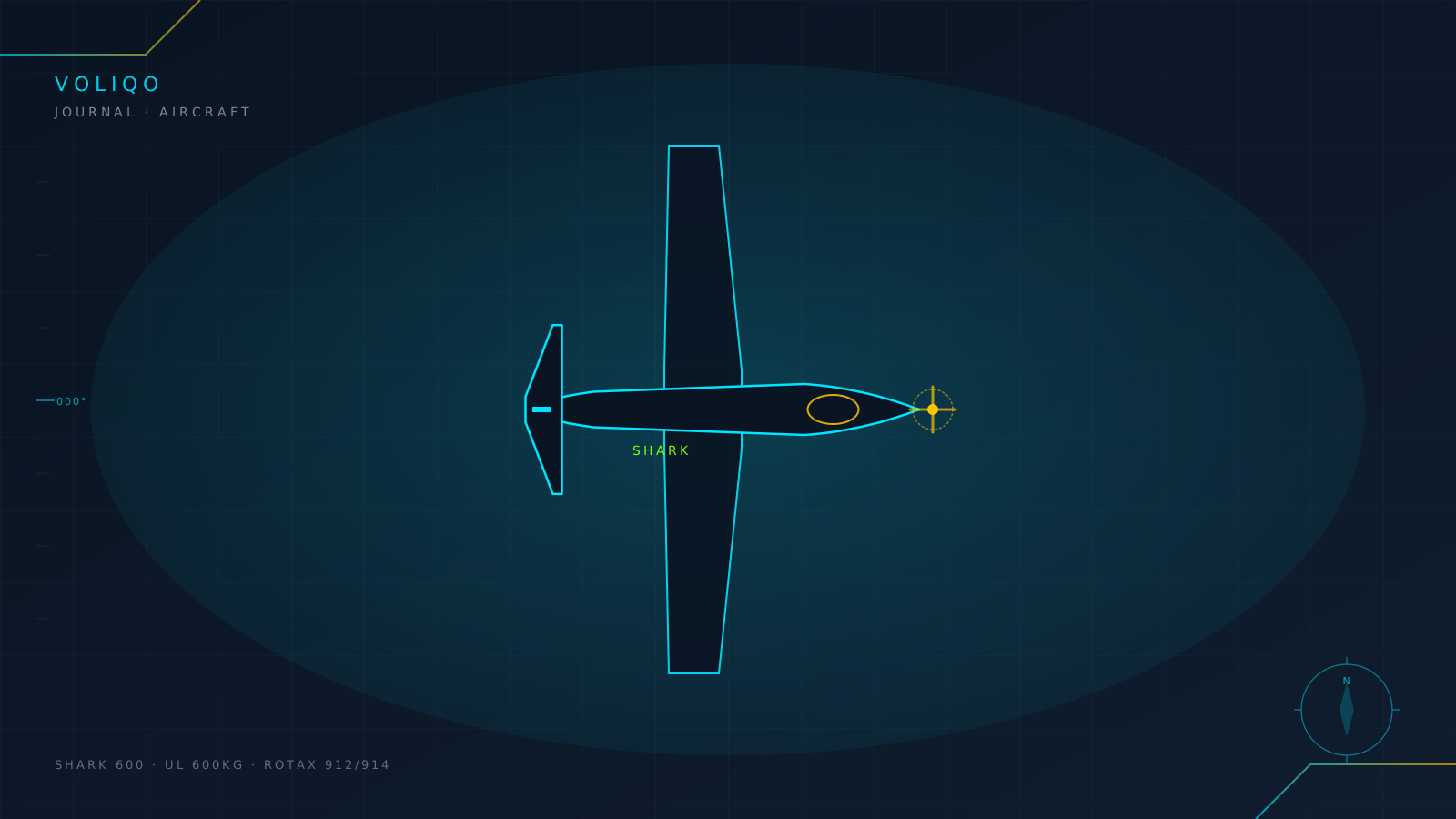
The Slovakian Shark is one of those airframes that punches well above its 600 kg weight class. The shape is the same shape that punched out a tandem-canopy speed record at 428 km/h. What changes between the two main variants in our catalog is everything that hangs off the firewall: the naturally-aspirated Rotax 912 ULS 100 hp in the Shark 600, and the turbocharged Edge Performance EP 914Ti Turbo 126 hp in the Shark 600T. Both fit the 600 kg ultralight envelope. Neither is the right answer in isolation. Here's how to choose.
What the spec sheets actually say
Side by side, with manufacturer-published numbers:
| | Shark 600 (912 ULS) | Shark 600T (EP 914Ti) | |---|---|---| | Power | 100 hp NA | 126 hp turbocharged | | MTOW | 600 kg | 600 kg | | Empty | ~310 kg | ~325 kg | | Useful load | ~290 kg | ~275 kg | | Cruise MSL | 300 km/h | 300 km/h | | Cruise FL100 | — (not certified for sustained altitude) | 350 km/h | | Range (75% + 30 min reserve) | 1958 km | — | | Range (ECO @ FL100 + 30 min reserve) | — | 3889 km | | Stall | 65 km/h (35 kt) | 65 km/h | | Service ceiling | 6,000 m | 5,500 m (FL180) with O₂ | | Climb | 5 m/s (1000 fpm) | 7 m/s (1380 fpm) | | Cruise fuel burn | 20 l/h @ 75% | 15 l/h ECO at altitude | | Take-off ground roll | 190 m | 190 m | | Fuel | 100 l | 100 l |
The single number that catches everyone's eye is the 600T's range: 3889 km at altitude, in ECO mode, on the same 100 l of fuel as the base 600. That's not a typo. The 914Ti Turbo, when allowed to settle into FL100 cruise on a lean ECO map, sips 15 l/h while pushing 350 km/h TAS. The base 912 ULS at sea level on 75% pulls 20 l/h to maintain 300 km/h. Maths: the 600T converts altitude into endurance the same way a turbocharged car converts intercooler density into torque.
Mission 1 — local recreational flying
If the typical mission is a 30-minute pattern session, hopping between airfields within 100 nm, or showing the airplane to friends on a Saturday morning, the base Shark 600 is the right answer.
Why:
- Sea-level cruise is identical (300 km/h) — no benefit from the turbo
- Maintenance is simpler (no turbo wastegate, no bypass valve, no boost-controller calibration)
- Mogas is enough — Avgas only as a backup
- Engine reliability data on the 912 ULS is the largest dataset in light aviation (>100 million hours)
The price difference between the two engines is significant — the EP 914Ti adds roughly the cost of a small car to the airframe price. For a pilot who never climbs above 5,000 ft, that money buys a lot of fuel and a lot of training time.
Mission 2 — cross-country at altitude
If you regularly do 600+ km legs, cross mountain ranges, or want to file VFR-on-top above weather, the Shark 600T's turbo earns its keep.
Concretely:
- A 700 km leg from Lecco to Munich: the 600T flies it non-stop at FL080–FL100, ETE ~2h, fuel ~30 l. The base 600 also makes it non-stop, but at sea level burning 20 l/h headwind-vulnerable.
- Crossing the Alps below MEA (minimum en-route altitude): the base 600 can do it via valley routes (slower, weather-dependent). The 600T just climbs to FL150 with O₂ and goes over.
- A round-trip Sicily–Slovenia: the 600T does it on one fuel stop. The base 600 does it on two.
The 600T pilot should plan for the supplemental oxygen system above FL120 (legally required at FL125 sustained in most jurisdictions). That's another consumable plus a pre-flight checklist line.
Mission 3 — flight school / training
The base Shark 600 is the better trainer, despite its tandem layout being unusual for ab-initio. Reasons:
- Engine-handling is simpler — no boost discipline to teach
- Stall characteristics are identical between the two variants, so transition to 600T later is straightforward
- The 100 hp power is plenty for the airframe; the extra 26 hp of the 914Ti at low altitude is wasted in pattern work and arguably makes go-arounds more aggressive
That said, almost no one uses a Shark as a primary trainer — the tandem seating and high cruise speed make it a pilot's-pilot machine, not a student's-student machine. If a school is buying one Shark, it's for time-building and instrument-introduction, not for first-solo work.
Cost-of-ownership math
Variable costs (per flight hour) are surprisingly close:
- 600 at 75% cruise: 20 l × €2.30 (Mogas) = €46/h fuel; engine reserves (TBO 2,000 h, overhaul ~€18,000) = €9/h; oil + filters = €4/h. Total fuel + engine ~€59/h.
- 600T at FL100 ECO: 15 l × €2.40 (slightly higher Mogas at altitude airfields) = €36/h fuel; engine reserves (TBO 1,200 h, more expensive overhaul) = €18/h; oil + filters = €4/h. Total fuel + engine ~€58/h.
Almost identical at the operating margin. The capex gap is what matters: the 914Ti adds ~€20,000 to the new airframe price. If you fly 200 h/year, the 600T pays itself back in fuel savings only if you spend most of those hours at FL100 ECO. For a 50 h/year pilot doing local flying, the base 600 is roughly €20k cheaper to own.
What about the 915iS variant?
We also catalog a Shark 600 with the Rotax 915iS Turbo 141 hp. Spec-wise it sits between the 600 and the 600T: more power than the base, simpler than the EP 914Ti, with FADEC monoleva control instead of carb + boost-controller. Manufacturer-published cruise around 340 km/h at FL100 and ~2200 km range. As of 2026 the 915iS Shark is rarer in the field; if you're shopping new and crave the turbo without the EP-specific maintenance ecosystem, ask Shark.aero about availability. Used-market data is still thin.
A buying matrix
| Mission | Pick | |---|---| | ≤100 nm pattern + local | Shark 600 | | Cross-country sea-level | Shark 600 | | Cross-country altitude (FL080+) | Shark 600T | | Mountain crossings | Shark 600T | | Time-building / hour-padding cheap | Shark 600 | | Showing off | Shark 600T (the climb is theatrical) | | Tight budget | Shark 600 | | Future-proof for IR transition | Shark 600T (altitude capability matters) |
Bottom line
The base Shark 600 is the better dollar-per-mission bet for the average UL pilot — sea-level cruise is identical, maintenance is simpler, and the engine has the largest reliability dataset in the class. The 600T is for the pilot who actually flies above the cloud-base and wants to convert that into 50% more range or a meaningful weather-out option. If your hangar logbook shows >50 hours per year above 5,000 ft, the turbo earns its keep. If it doesn't, the money's better spent on dual XC training or a panel upgrade.
Try both at a demo if you can. The pulse of the EP 914Ti at full boost is, for what it's worth, a memorable thing to feel in a 600 kg airplane.