Stall speed, density altitude, and the summer killer
Your published Vs0 is at sea level, 15°C, dry air. On a 35°C afternoon at 4,000 ft elevation, the same airplane stalls at 75 km/h instead of 65. Density altitude turns a familiar airplane into a marginal one.
The Vs0 (stall speed, full flaps, gear down) of your airplane is published in the POH as a single number — 65 km/h, say. That number is at sea level, 15°C, dry air. On a 35°C summer afternoon at 4,000 ft elevation, the same airplane stalls at 75 km/h. The 10 km/h difference doesn't sound like much, but it changes everything: take-off roll doubles, climb rate halves, service ceiling drops thousands of feet, and the margin between approach speed and stall speed gets uncomfortably thin. Density altitude is the invisible factor that turns a familiar airplane into a marginal one. This is the practical guide.
What density altitude is
The atmosphere is denser when it's cooler and drier, less dense when it's warmer and wetter. Aircraft performance depends on air density — the engine breathes denser air, the wing produces more lift in denser air, the propeller bites better.
Density altitude is the altitude in the standard atmosphere (15°C at sea level, decreasing 1.98°C per 1000 ft) at which the air would have the same density as your current location.
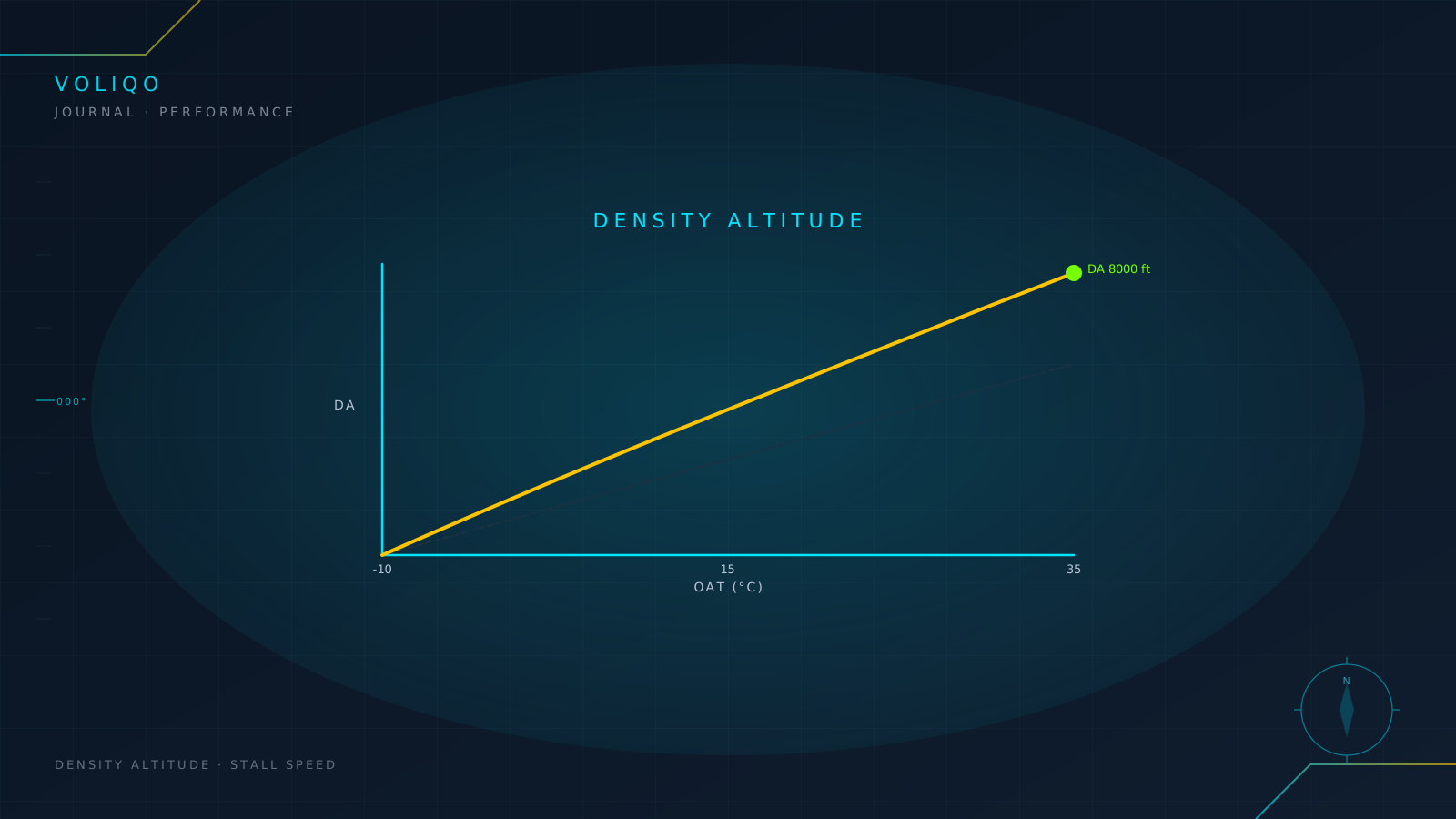
If you're at 4,000 ft elevation on a 35°C day, the air is much less dense than the standard 4,000 ft (which would be 7°C). The density altitude in this case might be 8,000 ft — meaning your airplane performs as if it were at 8,000 ft on a standard day.
A useful rule of thumb: density altitude ≈ field elevation + 120 × (OAT − ISA temp). For a 4,000 ft field on a 35°C day:
- ISA temp at 4,000 ft = 15°C − (1.98 × 4) = 7°C
- ΔT = 35°C − 7°C = 28°C
- DA ≈ 4,000 + (120 × 28) = 7,360 ft
That's roughly 8,000 ft of equivalent altitude for performance calculations.
What this does to performance
Three things degrade roughly proportionally to density altitude:
- Take-off roll: doubles every ~6,000 ft of DA increase
- Climb rate: halves every ~5,000 ft of DA increase
- Service ceiling: drops by approximately the DA gain
For a Tecnam P92 Echo MkII at sea level, 15°C: take-off roll ~250 m, climb ~1,000 ft/min, ceiling 14,000 ft.
Same airplane at DA 8,000 ft (e.g., 4,000 ft field, 35°C):
- Take-off roll: ~500 m (double)
- Climb rate: ~500 ft/min (half)
- Effective ceiling: 6,000 ft above current position (instead of 10,000 ft)
If the field is short (300 m grass strip in an Alpine valley) and DA is 8,000 ft, the airplane may not be able to take off at all, regardless of pilot skill.
What this does to stall speed
Stall speed varies with indicated airspeed stays roughly the same, but true airspeed changes with density altitude. For a fixed weight and configuration:
- Vs0 indicated stays at ~65 km/h
- Vs0 true airspeed at sea level = ~65 km/h
- Vs0 true airspeed at DA 8,000 ft ≈ 75 km/h
The pilot reads 65 km/h on the airspeed indicator, but the airplane is actually moving 75 km/h relative to the ground (in still air). Important implications:
- Approach speed margin: typical Vref = 1.3 × Vs0 = 85 km/h indicated. At DA 8,000 ft, that's still 85 km/h indicated, but it's actually 98 km/h TAS. Landing roll is longer at the same indicated speed.
- Take-off rotation speed: same indicated, but you accelerate to it more slowly because the airplane is thinner-aired, less prop thrust per RPM, less wing lift per AOA.
The summer + altitude trap
The combination that catches pilots:
- Field elevation 1,000–4,000 ft (anywhere in mountainous terrain)
- Mid-summer afternoon, OAT 30–40°C
- Light wind (no headwind benefit)
- Fully loaded airplane (or close to MTOW)
These four factors compound. A flight that's routine in cool morning conditions becomes marginal in afternoon heat.
Real example: a Tecnam P92 Echo MkII departing a 600 m grass strip at 2,500 ft elevation, MTOW (600 kg), 35°C, no wind, dry grass.
- DA ≈ 2,500 + 120 × (35 − 10) = 5,500 ft
- Take-off roll at sea level/15°C: 250 m
- Take-off roll at DA 5,500 ft: ~360 m (44% increase)
- Available runway: 600 m
- Margin: 240 m
That's still enough, but cut the runway to 400 m or add a 100 kg passenger and the margin disappears. Many summer-afternoon take-off accidents happen at exactly this point: pilot calculations from cool-morning training don't survive contact with summer afternoon density altitude.
The pre-flight density altitude check
Before any flight in summer or at altitude, do this 30-second check:
- Measure OAT at the airfield (your DG/EFIS shows it; or check the field's METAR)
- Note field elevation (chart, GPS, or memorized)
- Compute DA using the rule: DA ≈ elev + 120 × (OAT − ISA temp at elev)
- Compare DA to your aircraft's published service ceiling with margin
If DA is within 5,000 ft of your airframe's service ceiling, performance will be marginal. If it's within 2,000 ft, you may not be able to climb at all in level flight.
For Alpine pilots, this is a daily practice — fields above 3,000 ft elevation regularly hit DA 8,000+ ft on summer afternoons. The "fly in the morning" rule is universal in mountain UL operations.
How to mitigate density altitude
Three practical mitigations:
- Reduce weight: leave a passenger behind, take less fuel (to legal minimums + small margin), strip non-essential cargo
- Wait for cooler air: take off before 09:00 or after 18:00 in summer; mountain valleys cool fast after sunset
- Headwind: a 10 kt headwind shortens take-off roll by ~25% — meaningful margin
If you can't apply any of these and DA is high, don't take off. Wait, postpone, or change the destination.
Approach + landing in high DA
Density altitude affects landing too:
- Approach speed indicated is the same as low-DA approach
- True airspeed is faster, so ground speed is faster
- Landing roll is longer (more energy to dissipate)
For UL/LSA aircraft with 65 km/h Vs0 and 600–700 m landing rolls at sea level, plan +30% landing distance at DA 6,000 ft. A 300 m grass strip becomes a 400 m grass strip in your math.
Voliqo's planner
In the planner, the destination weather panel shows OAT and dew point. The aircraft selection includes service ceiling. The planner doesn't auto-compute DA (yet), but you have the inputs:
- Pull OAT from destination METAR
- Pull elevation from the airport detail
- Compute DA mentally (or with a phone calculator)
- Compare to the aircraft's ceiling — if DA > ceiling − 2,000 ft, plan for marginal performance
A future Voliqo enhancement: auto-compute DA and flag it in red when it exceeds 80% of the aircraft's service ceiling. For now, the discipline is on the pilot.
Bottom line
Density altitude is the silent performance killer in summer flying. The Vs0 you trained with becomes a different number on a 35°C afternoon at altitude. Take-off roll doubles. Climb halves. Ceiling drops.
The mitigations:
- Compute DA before every flight in summer or at altitude
- Take off in the morning when in mountainous terrain
- Reduce weight when DA is high
- Don't take off if DA puts you near service ceiling
The pilots who get caught are the ones who fly the same way in July as they did in March. The atmosphere doesn't care about your training memory — it cares about its current density.