Tecnam P2006T: a twin-engine certified IFR trainer powered by Rotax
When the P2006T was certified in 2009, the convention for CS-23 twin trainers was clear: two big-bore Lycomings, big fuel burn, big maintenance bill. Tecnam asked: does a twin really need to be that thirsty? Sixteen years later, the answer turned out to be no.
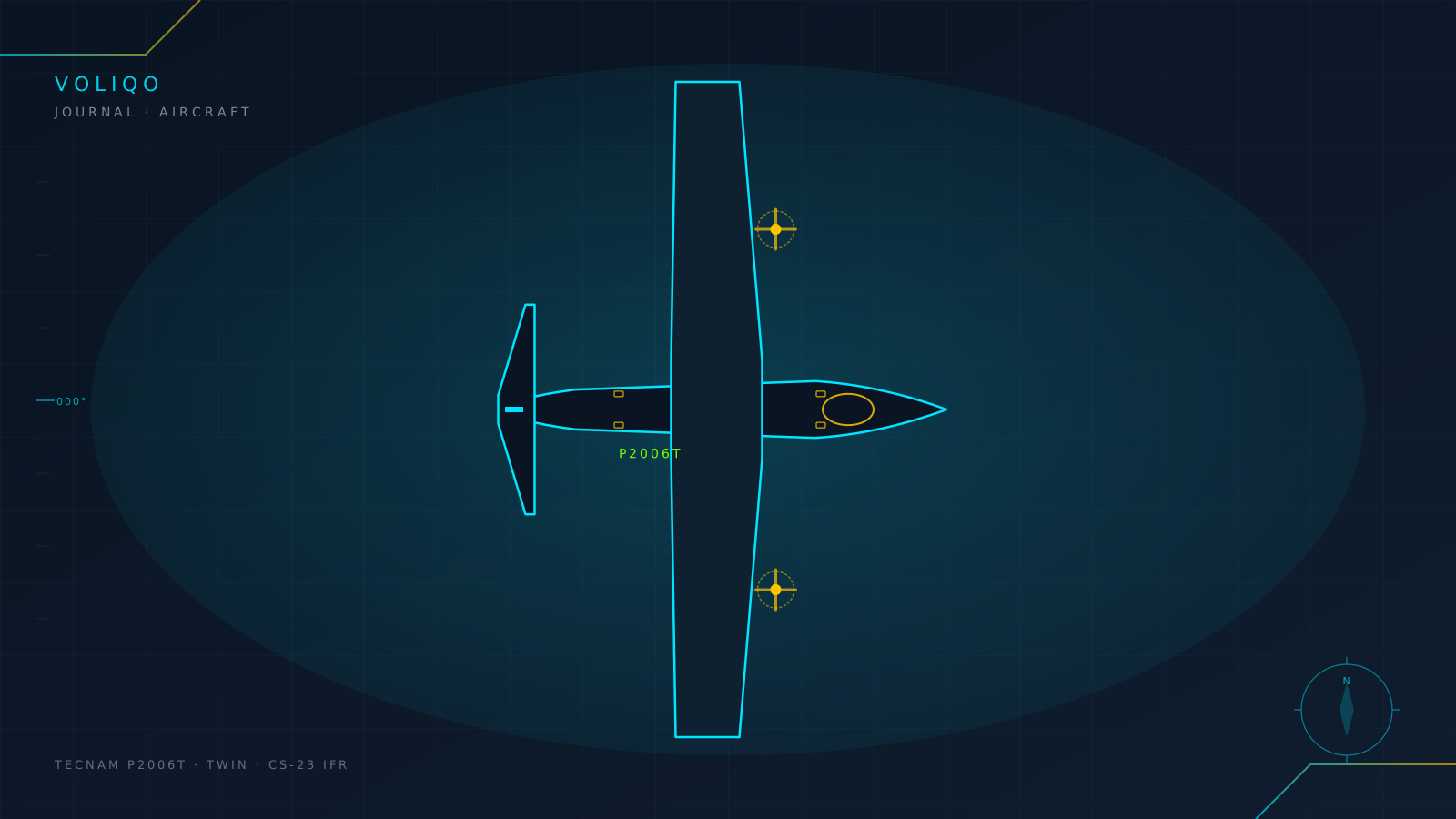
When the Tecnam P2006T was certified in 2009, the industry reaction was polite skepticism. The convention for CS-23 twin-engine training airplanes was clear: two big-bore six-cylinder Lycomings or Continentals, 200+ hp per side, big fuel burn, big maintenance bill. Tecnam showed up with two Rotax 912 100 hp engines and asked the question: does a twin really need to be that thirsty? Sixteen years and 400+ deliveries later, the answer turned out to be no.
The numbers, with no marketing dust
The P2006T baseline (Rotax 912S3 carbed):
- MTOW 1,230 kg
- Empty ~800 kg, useful load ~430 kg
- Cruise 145 kt max / 140 kt typical (259 km/h)
- Range 650–742 nm (1,204–1,370 km)
- Stall (VS0) 60 kt (111 km/h)
- Service ceiling 14,000 ft
- Climb 1,000 ft/min two-engine, ~250 ft/min single-engine
- Total fuel burn ~34 l/h at cruise (both engines)
- Engine TBO 2,000 h per Rotax
The newer P2006T NG variant replaces the carbed 912S3 with the fuel-injected 912iSc3, dropping cruise burn to ~28 l/h and bumping range to 930 nm (1,722 km). Same airframe, ~6 l/h cheaper to operate.
Why two Rotax 912s, not two Lycoming O-360s
The traditional ME-IFR trainer is a Piper Seminole with two Lycoming O-360 180 hp, burning ~17 USG/h (~64 l/h) total at cruise. The P2006T burns roughly half that. Over a typical 200-hour ATO training year per airframe, the fuel cost difference is €60,000–€80,000 per year depending on Avgas pricing. Across 10 years and 5 airframes in a fleet, that's a multi-million-euro line item.
The trade is power. 100 hp per side means the P2006T's single-engine climb at MTOW is around 250 ft/min — adequate to maintain altitude and complete an emergency divert, but nowhere near the 350+ fpm you'd see in a Seminole with one engine feathered. Pilots transitioning need to internalize early: the P2006T's blue-line speed (Vyse) and engine-out drag profile demand discipline. ATOs treat this as a feature — students arrive at their CPL/ME-IR rating with sharper engine-out skills than they would in a Seminole, where a 350-fpm reserve forgives a lot.
The retractable gear and what it adds
Unlike most "training" airplanes, the P2006T has retractable tricycle gear and a constant-speed propeller (one per side). This makes it a complete-trainer airframe — students get the full systems exposure (gear horn, gear warning, prop control, mixture management on the carb variant or single-lever on the iSc3) without needing to step up to a separate complex-systems aircraft.
For the rental and shared-ownership market, retractable gear means slightly higher hull insurance and a small risk of student-induced gear-up landings, but the complexity exposure is exactly what CPL syllabi require. Most ATOs treat it as net-positive.
The 912 as a twin-engine choice
The Rotax 912 has the largest accumulated flight-hour dataset in light aviation. As of 2026 the worldwide fleet has logged over 100 million hours. Reliability data is excellent — the 912 has a lower in-flight engine-out rate than the Lycoming O-360, and recovery from engine-out is faster (the engine restarts cleanly because the FADEC variants don't have manual mixture to mess up).
For a twin trainer, the high reliability rate is academically interesting (you actually get fewer real-world engine-out scenarios in training than in a Lycoming twin) but the simulated engine-out training is what ATOs care about. Pulling one Rotax to idle is no different from pulling one Lycoming — the student handles it the same way. So reliability is a maintenance-cost win, not a training-quality win.
What matters more for trainers: the 912 runs on Mogas. Avgas is increasingly hard to find at small ATOs — the P2006T can fuel from the same Mogas pump the school's UL fleet uses. One fuel tank, multiple aircraft types.
Single-pilot IFR operations
The P2006T is CS-23 IFR-certified. That changes who buys it.
Beyond ATO training, the P2006T has gained traction as a personal twin-engine touring airplane for IFR-rated owners who want twin-engine redundancy without the operating costs of a 200+hp twin. A Rotax-powered twin is the closest thing in 2026 to a Cessna 310 of the 1960s — sized for a family, capable of legal IFR, modest fuel bill.
The G1000 NXi panel + GFC700 autopilot makes it an easy single-pilot IFR airplane. AP coupled to RNAV approaches, emergency RAIM monitoring, full IFR situational awareness on a glass display. The flying is no harder than a Cirrus SR22 — easier in some ways because the autopilot handling has had two more decades of refinement.
The Special Mission cousin (P2006T SMP)
For completeness: there's a P2006T SMP variant (Special Mission Patrol) configured for ISR (Intelligence, Surveillance, Reconnaissance) and SAR (Search and Rescue). Same airframe, configurable mission palette, 2-pilot operations. Not relevant for civilian buyers, but it's worth knowing the airframe has a parallel certification ladder for government and surveillance customers — the engineering supply chain is well-funded and likely to outlast many smaller manufacturers.
What it costs to own
Used market as of 2026: a 2015–2018 P2006T is in the €350k–€450k range; a 2020+ NG with the iSc3 engines runs €500k–€650k. Operating cost (200 h/year):
- Fuel: ~€90/h (Mogas) or ~€110/h (Avgas)
- Engine reserves (2× Rotax overhaul ~€20k each at 2000h TBO): ~€20/h
- Insurance: 1.5–2.5% of hull value
- Hangar: depends on location
- Annual: ~€8,000–12,000 (twin complexity premium)
Total fixed + variable for a typical owner-operator: €180–€280/h all-in, vs €350–€450/h for a Seminole or a Diamond DA42. The cost gap is what makes the P2006T economically viable for owner-pilots, not just commercial trainers.
How to plan a flight in one
In Voliqo's planner, pick the P2006T or P2006T NG variant. The planner will pull these performance numbers automatically. The default route planning assumes both engines operating at cruise — for emergency single-engine planning (gear and flaps up, blue-line speed, max-continuous on remaining engine), use the manual override on cruise speed and recompute range from your current position to the nearest suitable airfield.
For comparison flights, the closest single-engine equivalent in the catalog is the P2010 TDI (cheaper to operate, longer range, single engine). The P2006T trades range and operating cost for the redundancy of the second engine.
Bottom line
The P2006T is what a CS-23 twin trainer becomes when you stop assuming the engines must be Lycomings. Half the fuel burn, similar performance envelope, modern panel, IFR-certified — and 400+ airframes worth of operational data confirming the formula works. ATOs get a cheaper trainer that produces sharper engine-out pilots. Personal owners get an IFR-capable family twin at half the per-hour cost of the established alternatives.
It's not the fastest twin, it's not the longest-range twin, and it's not the cheapest to acquire. It is the one most likely to earn its way out of the operating budget over a 5–10 year ownership horizon. For pilots and ATOs who care about sustainable operating costs, the P2006T is the airplane the rest of the twin trainer market is slowly being forced to copy.