Tecnam P2012 Traveller: how Cape Air bet 100 aircraft on a piston twin
Cape Air operates the densest network of small-airport scheduled service in the US. When their Cessna 402 fleet started aging out, the replacement wasn't a turboprop — it was a clean-sheet Italian piston twin. They ordered 100.
Cape Air operates the densest network of small-airport scheduled service in the United States — Cape Cod, Massachusetts island routes, Caribbean inter-island, the New England commuter shuttle. For thirty years their workhorse was the Cessna 402: a twin-piston nine-seater built between 1967 and 1985, perfect for 100–250 nm legs to airfields without instrument approaches or jet bridges. By 2018 the 402 fleet was approaching the practical end of its lifecycle. The 402 production ended decades ago. Maintenance was getting expensive. The replacement question was open.
Cape Air's answer wasn't a turboprop. It wasn't an electric vehicle prototype. It was a clean-sheet Italian piston twin called the Tecnam P2012 Traveller. They ordered 100 of them.
The numbers, with no marketing dust
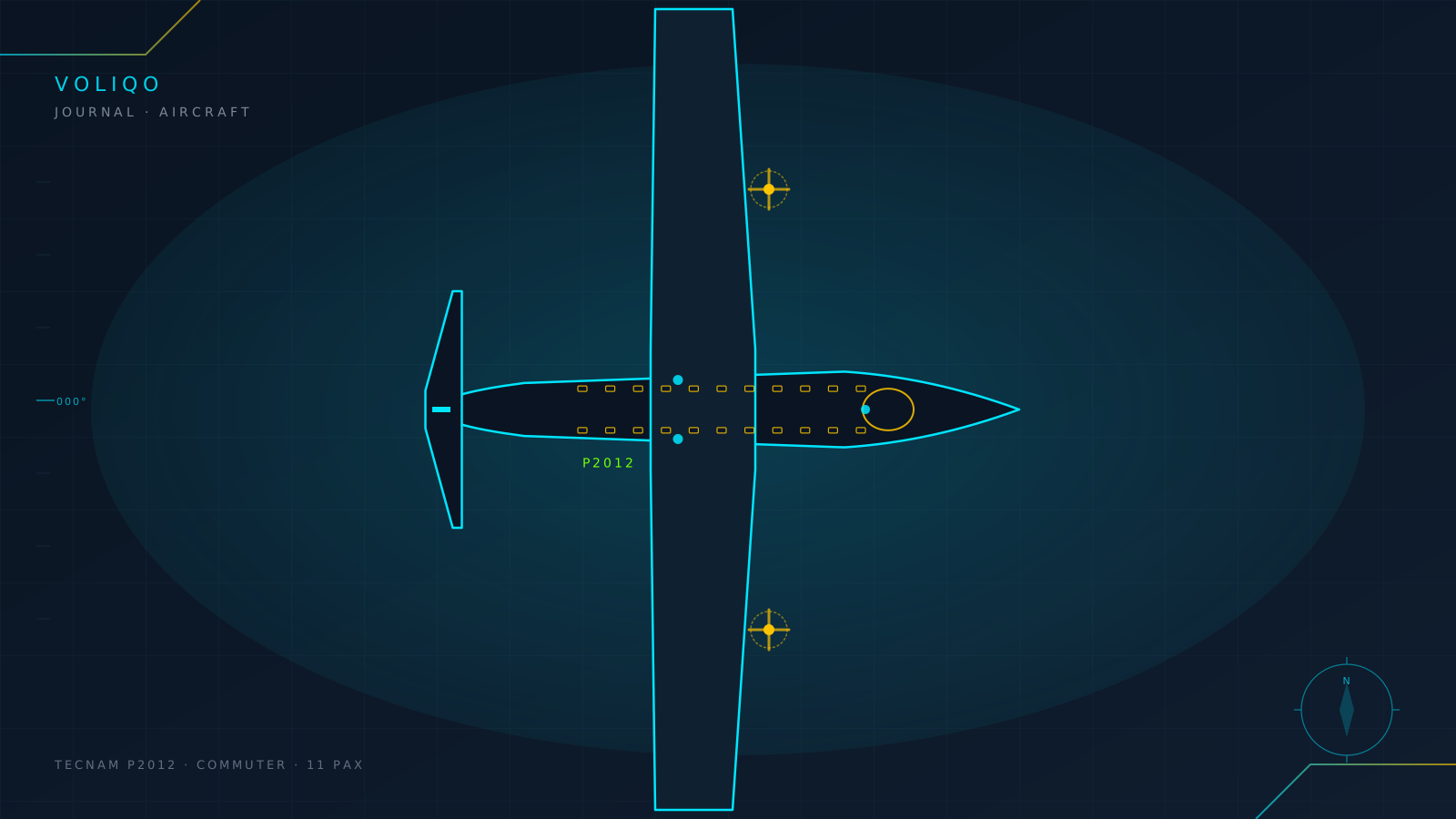
The P2012 Traveller is a high-wing, fixed-gear, twin-piston commuter:
- Configuration: 11 passenger seats + 1 pilot (or 9-pax + 1 pilot in some interior configurations)
- Engines: 2× Lycoming TEO-540-C1A, 375 hp each, turbocharged
- MTOW: 3,680 kg
- Empty: ~2,300 kg, useful load ~1,380 kg
- Cruise: 194 kt (359 km/h)
- Range: 950 nm (1,760 km)
- Stall (VS0): 60 kt (111 km/h)
- Service ceiling: 19,500 ft (5,943 m)
- Climb: 1,300 ft/min at MTOW
- Total fuel burn: ~110 l/h cruise (both engines)
- Take-off ground roll: ~500 m
The P2012 STOL variant trades some cruise speed (185 kt vs 194 kt) for a much shorter take-off — useful for tight airfields where the standard P2012 would marginal.
Why a piston twin in 2026
The intuition is that piston twins are obsolete — turboprops or single-engine PT6s should be the answer for any commuter slot above 500 nm. The math turns out to be more nuanced.
For a 150–300 nm leg with frequent turnarounds (Cape Air's profile):
- A turboprop (PT6-powered Caravan or Pilatus PC-12) is faster and has higher fuel cost per hour, but the per-trip economics are dominated by capital cost. New PC-12 = $5M+. Used Caravan = $2-3M.
- A piston twin (P2012) is slower but half the per-hour operating cost. New P2012 = $4M, but used P2012 in 5 years will be $2M.
- For 200 nm legs with 4 turnarounds/day, the trip-time difference between 194 kt and 250 kt is ~15 minutes. The cost difference at scale is meaningful.
For Cape Air specifically: the airline doesn't need 250 kt cruise — their longest single-leg is around 200 nm. Picking 194 kt and saving 40% on fuel + capex is the right answer.
What 1,380 kg of useful load buys
The P2012 carries 11 passengers + 1 pilot + bags + fuel within 3,680 kg MTOW. With full fuel (~750 kg) and 12 occupants at average 80 kg + 15 kg bag each = 1,140 kg, total = 1,890 kg + airframe 2,300 kg = 4,190 kg... too heavy. Operationally:
- Full fuel + 8 pax: 750 kg fuel + 760 kg pax/bags = 1,510 kg useful → 13 kg under MTOW. Just works.
- Full pax (11+1) + fuel reduction: 12 × 95 kg = 1,140 kg pax/bags + 240 kg fuel (180 l, 90 min flight) = 1,380 kg useful = exact MTOW.
- Full pax + cargo + minimum fuel: typical commuter operation. ~50 nm legs with 30 min reserves.
In practice, a 200 nm Cape Air leg flies with 11 passengers and ~340 kg of fuel (~250 l, fuel for the leg + 30 min IFR reserve). The airframe is operating well within margins.
The TEO-540 engine choice
Lycoming's TEO-540 is the modern, FADEC-controlled, turbocharged version of the venerable O-540. Single-lever power management, electronic ignition, no manual mixture, no propeller pitch control to manage independently. For a commuter pilot doing 4–6 turnarounds a day, the simplicity matters: less to manage, fewer mistakes, less pilot fatigue across a 10-hour duty day.
The trade vs a PT6 turboprop:
- TEO-540: $200,000 per engine new, 2,000h TBO, $50,000 overhaul
- PT6A-114: $750,000 per engine new, 3,500h TBO, $250,000 overhaul
Per-hour engine cost at TBO: TEO-540 = $25/h × 2 engines = $50/h. PT6 = $70/h × 1 engine = $70/h. Piston twin wins on engine reserves alone.
Fuel? TEO-540 burns 110 l/h (Avgas, ~€2.50/l) = €275/h. PT6 burns 250 l/h Jet-A1 (€1.80/l) = €450/h. Again the piston wins per hour, even though Avgas is more expensive per litre.
The Sentinel SMP — same airframe, different mission
The P2012 Sentinel SMP variant is the surveillance/maritime patrol version. Same airframe, mission-configured interior with radar, EO/IR turret, SIGINT antenna, AIS receiver, ASW capability. Used by coast guards and government surveillance operators. Not directly relevant for civilian buyers, but it's worth knowing the airframe has a parallel certification ladder for government customers — that funding stream stabilizes the engineering supply chain and makes the airframe more durable as an investment for civilian operators.
The economics of regional aviation in 2026
Cape Air's 100-airframe order isn't an outlier. Other regional operators are looking at similar replacement cycles:
- The Cessna 402 fleet is shrinking — most remaining airframes are 40+ years old
- The Beech 1900 turboprop is also aging out — operators want a smaller, cheaper alternative
- The Caravan 208 is good for some routes but heavier on fuel for short legs
- New entrants like Tecnam P2012 are picking up the gap
The market dynamic favours operators who can match airframe size to route economics. A 9-seat commuter on a 60-mile island hop doesn't benefit from a 19-seat turboprop's range capability. The right tool for the job is small, twin-engine for redundancy over water, and cheap to operate. The P2012 fits that envelope.
What this means for non-commuter operators
For a private buyer, the P2012 is overkill in seat count but right-sized for cost: a family + extended family + a lot of cargo, or a corporate operator running shuttle flights between facilities. Used market when the first Cape Air retirements hit (around 2030–2035) will likely produce attractive pricing for owner-operators in the $1.5–2M range.
In Voliqo's planner, the P2012 catalogues with its full performance envelope — useful for benchmarking against the P2006T twin (smaller, half the seats, half the operating cost) for buyers who don't need 11 seats.
Bottom line
Cape Air's bet on the P2012 isn't nostalgic loyalty to piston engines. It's an economic calculation that the per-hour cost of a modern Lycoming TEO-540 twin beats a single PT6 turboprop for the specific niche of 100–300 nm commuter operations with frequent turnarounds. As of 2026, that calculation continues to hold — and Tecnam's order book reflects it.
For a private pilot, the P2012 is a niche aircraft — too big, too expensive for personal use. For an operator running scheduled service to small airports, it might be the most rational airplane in the catalog.