Tecnam P92 Echo MkII: a pilot's first look
The P92 Echo has been the friendly face of Italian ultralight aviation for almost three decades. The MkII takes that heritage and gives it a carbon-fibre fuselage, an updated panel, and a fully-injected Rotax engine option.
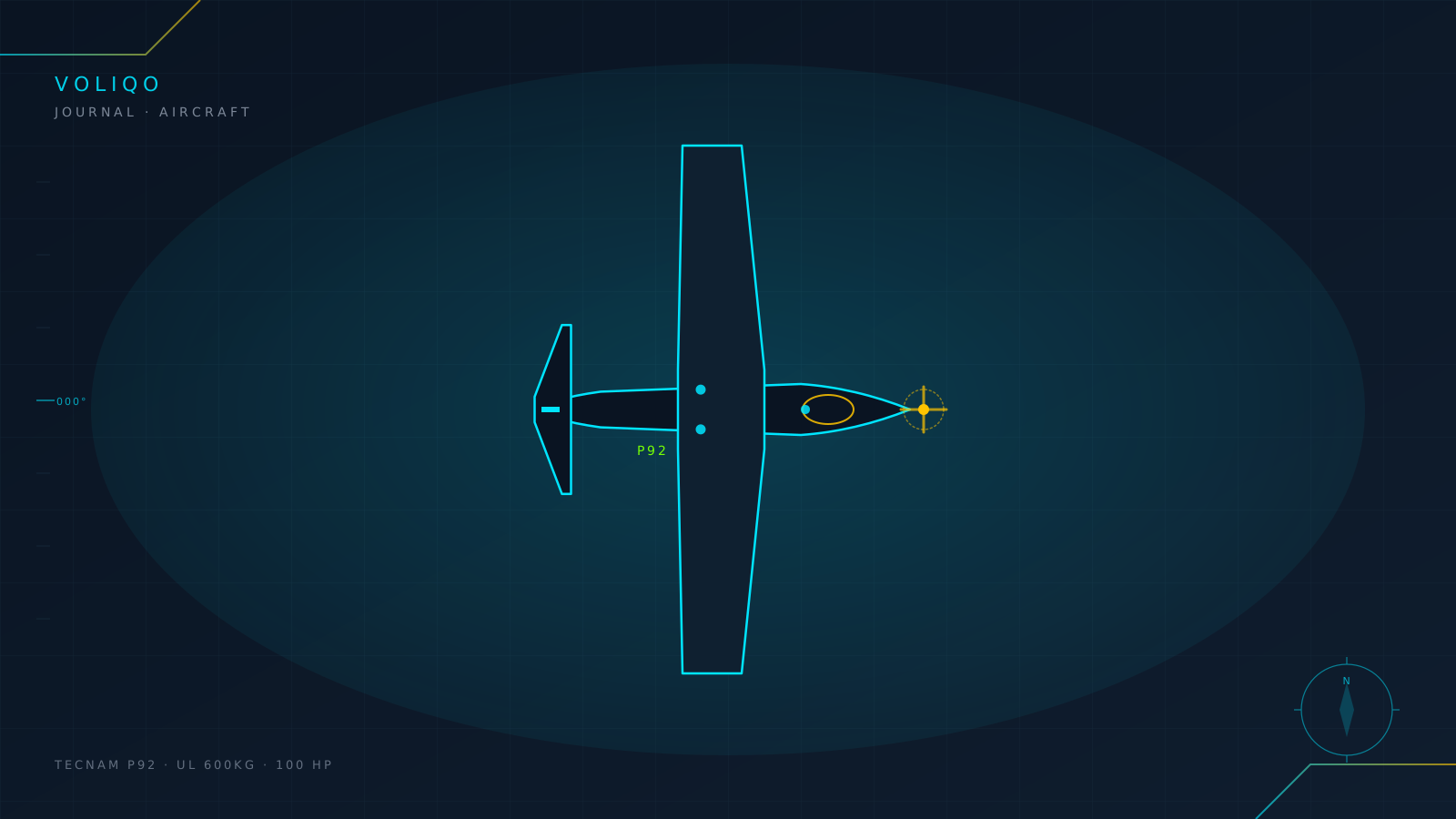
The P92 Echo has been the friendly face of Italian ultralight aviation for almost three decades. The MkII generation, in production since 2019, takes that heritage and gives it a carbon-fibre fuselage, an updated panel, and a fully-injected Rotax engine option. If you're shopping for a 600 kg ultralight or LSA, or if you're a flight school deciding what to put your students into next, the P92 Echo MkII is going to land on your shortlist. This is what it actually flies like, and who buys one.
The numbers, with no marketing dust
Let's get the brochure side out of the way. Tecnam's published data for the MkII with the Rotax 912 ULS2 100 hp engine:
- MTOW 600 kg — the European UL ceiling, also LSA-eligible at 600 kg empty + 250 kg useful
- Empty weight ~320 kg, leaving roughly 280 kg of useful load
- Range 1296 km (700 nm) with full fuel and a 30-minute reserve
- Cruise 213 km/h TAS at 75% power (115 kt)
- Stall (VS0) 70 km/h with full flaps (38 kt)
- Service ceiling 14,000 ft
- Climb rate ~1000 ft/min at MTOW on a standard day
- Fuel 90 l in two 45 l wing tanks, burning ~17 l/h at cruise
Those numbers describe a balanced two-seat tourer that can do an actual cross-country and not just laps in the pattern. The 700 nm range puts most of mainland Europe within a single fuel stop from a starting point in northern Italy.
What it feels like in the pattern
The P92 Echo MkII has a high-wing, fixed-gear, side-by-side layout — exactly what most students train on. The differences from a Cessna 152 you'd actually feel:
- The cockpit is wider. Two ANR-helmeted shoulders fit without rubbing.
- The control feel is lighter, especially in roll. The 912 spins a smaller propeller than a 152's Lycoming O-235, so torque effects are mild.
- Visibility is better in the descent. The lower cowling and high-set windscreen mean you can actually see the threshold during base-to-final.
- Stall break is benign. Wings down, ailerons effective, no wing-drop tendency in any sane configuration.
Where the airframe shows its UL DNA: it's lighter than a 152, so it dances more in turbulence. A 15 kt crosswind feels heavier on the rudder than the Cessna does, but stays well within the 16 kt demonstrated.
The Rotax 912 ULS2 question
The base MkII ships with the 912 ULS2 — a carburetted, naturally-aspirated 100 hp 4-stroke. There is also a 912 iSc3 fuel-injected option (p92-912is in our catalog) and a 915iS turbo variant (p92-915is) that pushes service ceiling to 18,000 ft and cruise around 250 km/h.
For a flight school, the carburetted 912 is the right answer: cheaper to buy, simpler to maintain, runs on Mogas (and Avgas if Mogas isn't available), and your A&P probably already has a Rotax line manual on the shelf. For private cross-country use, the iSc3 saves about 3 l/h at cruise and starts more reliably in cold weather. The turbo only makes sense if you regularly cross the Alps or operate above 6,000 ft DA.
What you can do with it
In Italy, registered as a UL (the "VDS" certificate, 600 kg post-2019 reform), the P92 Echo MkII can be flown by a UL licence holder day-VFR for personal use. With an LSA registration in countries that recognise it, you get day-VFR for commercial training. With the optional EASA CS-VLA route (the P2008 JC sibling does this) you unlock night-VFR and the path to IFR — but the P92 Echo MkII itself is not CS-VLA-certified, so plan accordingly.
A typical mission profile for an owner:
- Local flying out of a 500 m grass strip — full MTOW, no problem
- Day trip to a coastal airfield 250 nm away — comfortable, fuel for the return
- Cross-country to another country with a 1-stop fuel — well within range; pick destinations 350–500 nm out for an easy flight
- Multi-day touring — yes, with proper baggage discipline (the 280 kg useful load is honest)
Who buys one
The P92 Echo MkII has three buyer profiles we see repeatedly:
- The stepping-up student — finished UL training, wants a forgiving cross-country machine that won't bite, doesn't need 200+ knots, and can be hangared at a small airfield
- The flight school — replacing tired 152s or older P92 MkI airframes, wants a parts pipeline that's still young, training-airframe support, and a modern panel for student transition
- The retired CPL — flew Cessnas and Pipers their whole career, downsizing to UL, wants something that handles like a real airplane and not a kite
If you're buying second-hand, the MkII is a 6-year-old design at most as of 2026, so you're either buying new (~€140k–€180k depending on engine and panel) or 2–4 years old with low hours.
How to plan a flight in one
If you're using Voliqo, pick the P92 Echo MkII from the catalog, set your departure and arrival, and the planner will pull these performance numbers automatically. The defaults — 90 l fuel, 17 l/h burn, 213 km/h cruise, 10% reserve — match the published Tecnam datasheet. Adjust the reserve up if you're flying near coastal weather or over terrain. The range circle around your departure shows whether your destination is single-leg or whether you'll need a fuel stop.
For comparison flights, the closest competitors in the catalog are the Tecnam P2002 Sierra MkII (low-wing, slightly faster) and the Shark 600 (slick canopy, much faster cruise).
Bottom line
The P92 Echo MkII is what an honest two-seat trainer-tourer should be in 2026: a balanced, modern, properly-supported airframe with three engine options, a high-wing layout that students learn to land cleanly, and 700 nm of range that genuinely turns it into a cross-country machine. It's not the fastest UL, it's not the longest-range UL, and it's not the cheapest. It is, however, the one most likely to still have factory parts support in 20 years, and that matters when you're spending €150k.
If you're shopping in the UL/LSA bracket and the spec sheet doesn't tell you something obvious to disqualify the P92 Echo MkII, fly one before you decide. It rarely loses the flyoff.