UL 600 kg vs LSA vs CS-23: which class fits your flying?
The certification ladder — UL, LSA, CS-23 — decoded for what each class can actually do, what it costs, and who it's for. Practical comparisons with real aircraft from the catalog. The single piece of paperwork that decides what missions are legally available to you.
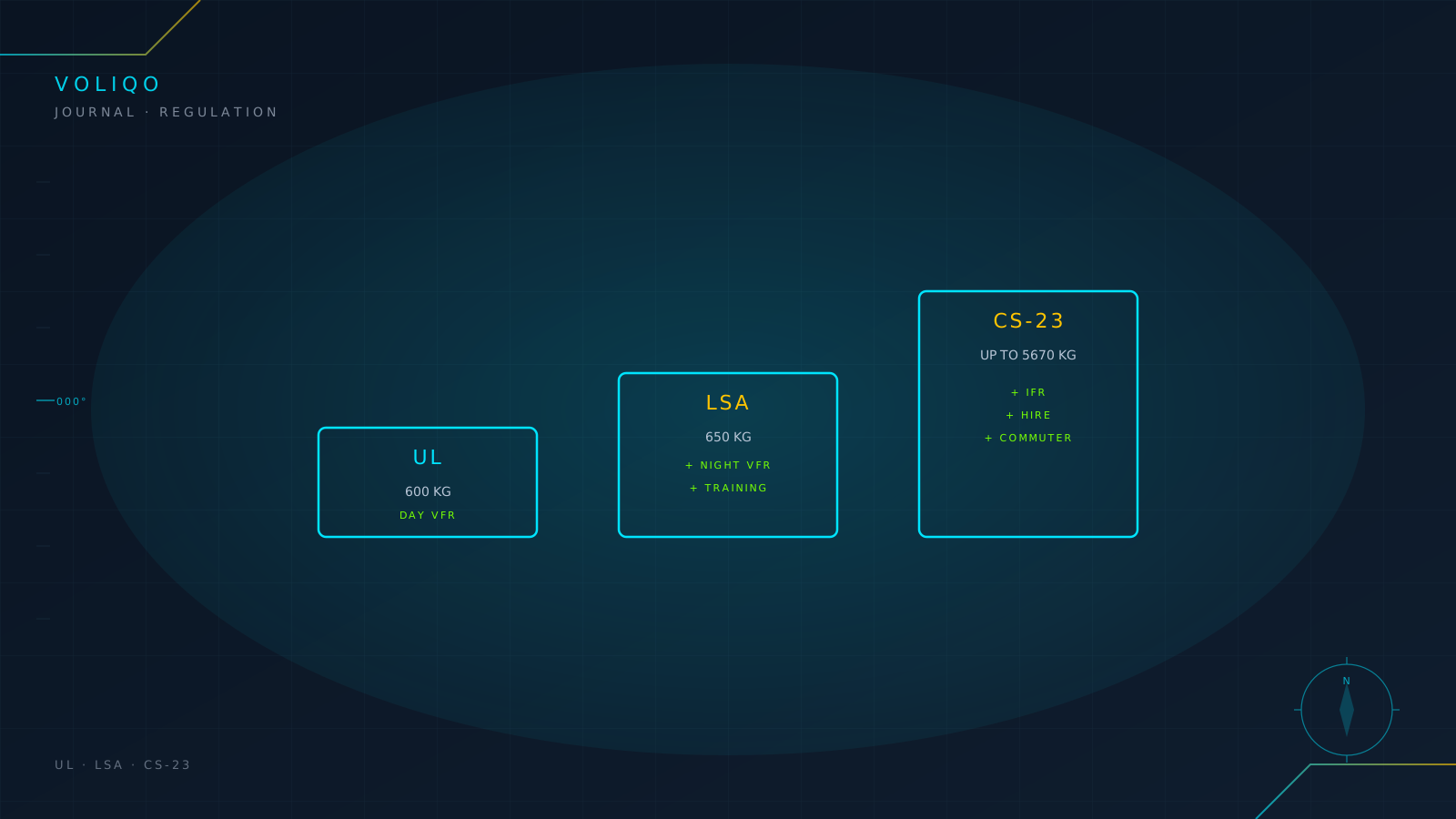
Most pilots learn the certification ladder by trial and frustration: bumping into a rule that says "you can't do that with this airplane in this jurisdiction with this licence" and only then digging into why. The three categories that cover almost all light-aviation flying — UL (Ultralight), LSA (Light Sport Aircraft), and CS-23 type-certified — each have their own envelope of what they can and can't do, what they cost to own, and who they're for. This is the practical decoder, with no marketing dust.
The certification ladder in one paragraph
Three regulatory regimes, lightest to heaviest:
- Ultralight (UL): National-level rules, harmonized to a 600 kg MTOW ceiling in most countries post-2019. Day-VFR for personal use is the default; what else is possible varies by country.
- Light Sport Aircraft (LSA): Industry consensus standard (ASTM F2245), bridged into EASA via the LSA category and into the FAA via Sport Pilot rules. Day-VFR with broader cross-border privileges, sometimes night, sometimes commercial.
- CS-23 type-certified: The "real" certification. Full EASA/FAA type certificate, with subclasses (CS-VLA for very light, CS-23 commuter for ≥9 pax, etc.). Anything is possible — night, IFR, paying passengers, hire-and-reward — provided the specific airframe carries the certification.
Each step adds capability and cost, in roughly this proportion: capabilities double and operating costs 1.5x with each step up.
What you can do in each class
The blunt comparison:
| | UL 600kg | LSA | CS-23 | |---|---|---|---| | Day VFR personal | ✅ | ✅ | ✅ | | Night VFR | varies / usually no | ✅ | ✅ | | IFR | no | varies / usually no | ✅ (if airframe certified) | | Cross-border | depends on bilateral | ✅ | ✅ | | Paying passengers (hire) | no | varies | ✅ | | Flight school commercial | usually no | ✅ | ✅ | | Maintenance — pilot-allowed | most of it | some | minimal | | Annual inspection | yearly, ~€1,500 | yearly, ~€2,000 | annual + 100h, ~€4,000+ |
Specifics vary by country. Italy and Germany have permissive UL regimes. France's UL regime is also robust but has different documentation requirements. The UK's UL regime maps to the BMAA (a self-administered body). The US has neither UL nor a perfect LSA equivalent — the closest US analogues are Light Sport (LSA) and Experimental.
The 600 kg UL reality
Post-2019 reform, most UL jurisdictions allow 600 kg MTOW. What that gets you in the catalog:
- Tecnam P92 Echo MkII — friendly trainer-tourer, 1296 km range
- Shark 600 — 300 km/h cruise, slick tandem two-seater
- Risen 912iS Max Range — 2400 km on a single tank, retractable gear
- Tecnam P2002 Sierra MkII — low-wing 600 kg with bubble canopy
What you give up vs LSA/CS-23:
- IFR not possible (no airframe in 600 kg UL is IFR-certified)
- Night flying usually restricted (varies — some countries permit, most don't)
- Cannot do paid commercial work
- Cannot fly into IFR-only airspaces or terminal procedures
What you gain:
- Lower acquisition cost (€80k–€250k typical)
- Simpler maintenance (often pilot-permitted)
- Mogas operation
- Permissive registration (national, not EASA)
The 600 kg UL is the sweet spot for personal recreational pilots flying day-VFR cross-country. It's also the right answer for pilots who already had a national UL licence pre-2019 and don't want to re-credential.
The LSA bridge
LSA was originally a US construct (FAA Sport Pilot rules) and has been progressively bridged into EASA. It's a category for airframes that satisfy ASTM F2245 — an industry standard codifying what counts as "light sport" — and it adds:
- Cross-border recognition more readily than UL
- Sometimes night-VFR (depending on national overlay)
- Eligibility for ATO commercial training in many jurisdictions
In our catalog, the Tecnam P2008 is the LSA-only sibling of the P2008 JC (CS-VLA). The aircraft are mechanically identical; the certification is what differs. Buyers pick LSA for cost, and CS-VLA when they need night/IFR potential.
The CS-23 ceiling
CS-23 is the EASA equivalent of the FAA's Part 23 — full type-certified general aviation. The subclasses matter:
- CS-VLA (Very Light Aircraft, ≤750 kg MTOW): two-seat day-VFR + sometimes night-VFR. Examples: P2008 JC.
- CS-23 SEP (single-engine piston): Examples: P2010-180, P2010-215, P-Mentor (IFR-certified).
- CS-23 IFR: airframes specifically certified for instrument flight. The P2010 TDI and P-Mentor are both in this group.
- CS-23 Twin: twin-engine, IFR-certified. P2006T and variants.
- CS-23 Commuter: ≥9 passenger seats. The P2012 Traveller sits here.
CS-23 unlocks everything: night, IFR, hire-and-reward, paid passengers, ATPL training, scheduled service. The cost is real:
- Acquisition typically €200k–€5M+
- Annual inspections + 100-hour inspections
- Mandatory life-limited parts replacement
- Higher insurance
- Mostly Avgas (some diesel/Jet-A1 options like the P2010 TDI)
How to choose
The question to ask yourself, in order:
- Will you fly at night or IFR? If yes → CS-23. UL and most LSA can't do this.
- Will you fly for hire (passengers, training)? If yes → LSA or CS-23 depending on the kind of operation. Not UL.
- Will you cross national borders frequently? If yes → LSA or CS-23. UL bilateral recognition is patchy.
- Is this a recreational airplane for personal day-VFR flying? If yes → UL is the cheapest, and the catalog's UL options are excellent.
- Do you fly 100+ hours a year? If yes → CS-23 amortizes the higher capex. If no → UL or LSA make more economic sense.
- Maintenance comfort: do you want to do your own annual? UL allows the most pilot-maintenance. CS-23 requires licensed AMEs.
Cost-of-ownership at a glance
For a 100 h/year private pilot:
- UL (Shark 600 / P92 / Risen 912iS): capex €120-250k, hourly all-in €70-110
- LSA (P2008): capex €200-280k, hourly all-in €90-140
- CS-23 SEP (P-Mentor / P2010-180): capex €350-550k, hourly all-in €130-200
- CS-23 Twin (P2006T): capex €400-650k, hourly all-in €180-280
- CS-23 Commuter (P2012): capex €3-4M, hourly €600-900 (operator economics, not personal)
The capex gap from UL to CS-23 SEP is roughly 3x; the hourly operating cost gap is roughly 2x. CS-23 makes economic sense if you can use the extra capability (night, IFR, faster cruise) often enough to justify the bill.
Bottom line
Pick the lightest certification class that does what you actually fly. Most pilots over-buy — they end up in CS-23 SEP airframes flying day-VFR local missions that a UL would handle for half the cost. A few pilots under-buy — they get a UL and then realize they can't legally fly the IFR cross-country mission they wanted.
In Voliqo's catalog, every airframe is tagged with its certification class. When you pick an aircraft for planning a route, the planner doesn't enforce certification (that's on you), but the metadata is there. Read the certification class line carefully before you commit to an airframe — it's the single piece of metadata that determines what missions are legally available to you.