SIGMETs: what they mean and when they ground you
A METAR tells you what the weather is doing right now. A TAF tells you what it's expected to do. A SIGMET tells you something stronger: a meteorologist has decided some weather phenomenon is dangerous enough that all aircraft need to know about it.
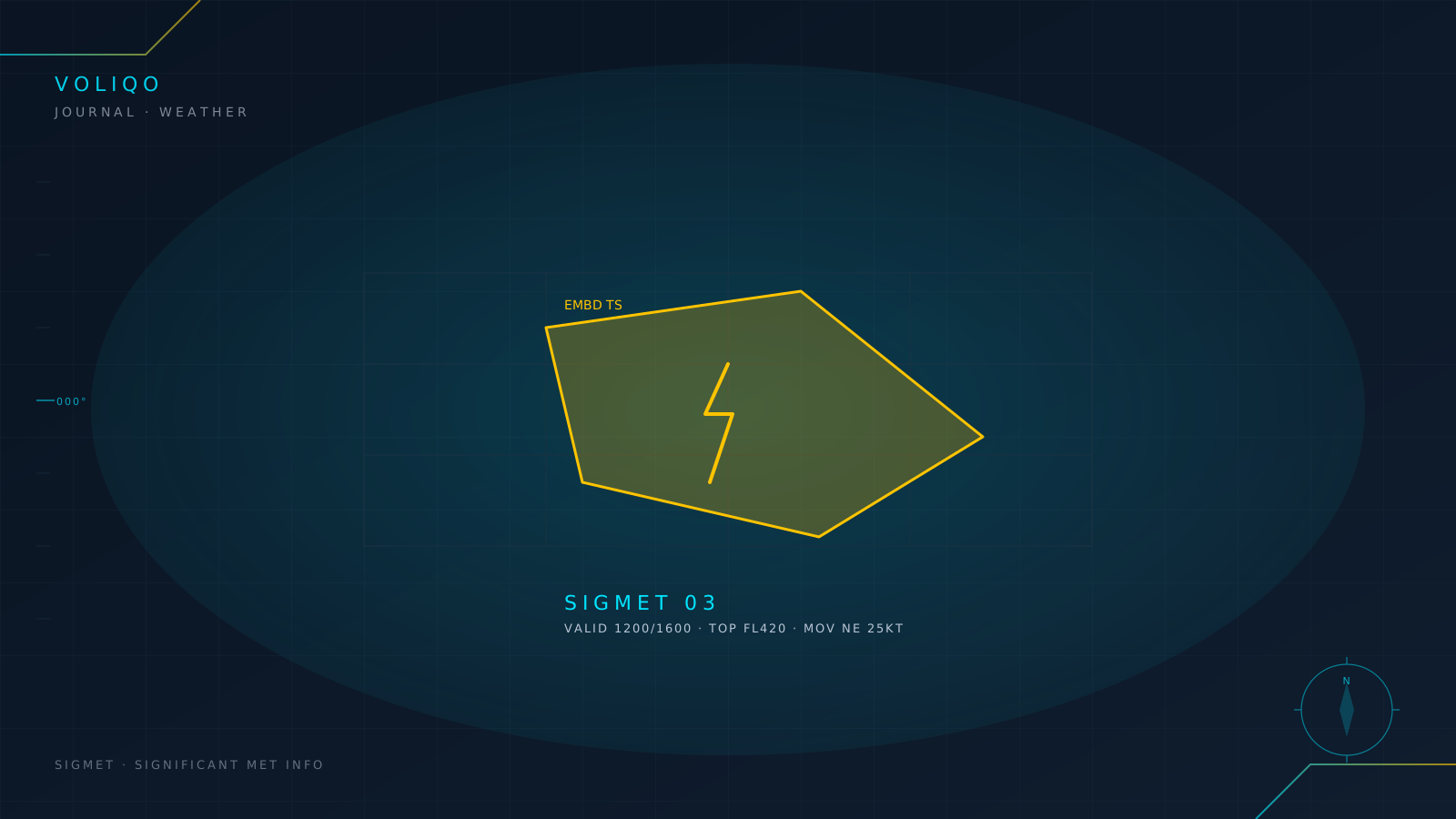
A METAR tells you what the weather is doing right now. A TAF tells you what it's expected to do. A SIGMET tells you something stronger: a meteorologist has decided some weather phenomenon is dangerous enough that all aircraft in a defined region need to know about it. SIGMETs are the meteorologist's flag — they don't appear for routine weather, only when something is genuinely hazardous. If there's a SIGMET on your route, you re-plan or you wait. This is the practical guide.
What "significant" means
SIGMET stands for Significant Meteorological Information. The threshold for issuance is that a phenomenon poses a hazard to "the safety of all aircraft" — not just light aircraft, not just IFR aircraft. The phenomena that qualify (codified by ICAO):
| Code | Meaning | Why it grounds you | |---|---|---| | TS | Thunderstorm | Severe turbulence, hail, icing, lightning, wind shear | | ICE | Icing (severe) | Structural ice accretion can stall an airframe in minutes | | TURB | Severe turbulence | Loss of control, structural damage | | MTW | Mountain wave | Strong vertical air motion exceeding aircraft climb capability | | VA | Volcanic ash | Engine flameout, pitot blockage, structural abrasion | | DUST/SAND | Dust storm | Visibility, engine ingestion |
For UL/LSA pilots, TS, ICE, and TURB are the most common reasons to abort. VA is rare in most regions but a hard no-go anywhere it's issued. MTW is region-specific (Alpine corridors, Pyrenees lee waves). DUST is mostly a concern in southern regions on Saharan dust events.
A real SIGMET decoded
Here's a real SIGMET from the LIBB FIR (Brindisi flight information region):
LIBB SIGMET 03 VALID 141200/141600 LIBB-
LIBB BRINDISI FIR EMBD TS FCST WI N4030 E01700 - N4100 E01900 - N4030 E02100 - N3950 E01900 - N4030 E01700
TOP FL420 MOV NE 25KT INTSF=
Read it as:
LIBB SIGMET 03— third SIGMET issued by Brindisi todayVALID 141200/141600— valid 12:00 to 16:00 UTC on day 14 (4 hours)EMBD TS FCST— embedded thunderstorms forecast (embedded = inside cloud, not visible until you're in them)WI N4030 E01700 - N4100 E01900 - N4030 E02100 - N3950 E01900 - N4030 E01700— coordinates of the 5-vertex polygon defining the affected area. Read each pair as Latitude / Longitude. The polygon closes (the last point equals the first).TOP FL420— thunderstorm tops at flight level 42,000 ft (very tall — significant storm)MOV NE 25KT— moving northeast at 25 knotsINTSF— intensifying
The polygon roughly covers central-southern Italy. Tops at FL420 means this is a big storm. A 25 kt NE movement means the storm will move 100 nm in 4 hours — by 16:00 UTC the affected area will have shifted significantly.
How to read the polygon
The most useful skill: visualize the polygon on a map. The example above defines a 5-vertex polygon with vertices at:
- 40°30'N 17°00'E (off the Apulian coast)
- 41°00'N 19°00'E (over the Adriatic)
- 40°30'N 21°00'E (over Albania/Greece)
- 39°50'N 19°00'E (south Adriatic)
That's roughly a diamond covering the Adriatic and Ionian Seas. If your route is from LIRP (Pisa) to LIBR (Brindisi), the SIGMET says: don't go southeast of Pisa during the validity window. Reroute via the Tyrrhenian coast or wait 4 hours.
Voliqo's planner renders SIGMET polygons as filled overlays on the map. If your plotted route crosses a SIGMET polygon, the planner highlights the intersection — visually obvious.
Geographic vs temporal scope
A SIGMET has both:
- Geographic scope: the polygon (or sometimes a corridor)
- Temporal scope: the validity window (typically 4 hours; up to 6 for some phenomena)
For a 2-hour flight that's planned to start 1 hour after the SIGMET expires, the SIGMET doesn't ground you — it has expired. For a 5-hour flight that overlaps the validity window, you have to plan around it OR delay until it expires.
The validity is fixed at issuance — but new SIGMETs can be issued for the same area as the situation evolves. For thunderstorms, expect a re-issuance every 4–6 hours as long as the convective activity persists.
What VFR pilots should do
The conservative VFR rule: avoid the polygon by at least 20 nm. For TS specifically, the FAA recommends 20 nm of clearance from any cumulonimbus; SIGMET polygons are usually drawn with margin already, but adding your own 20 nm is good discipline.
For ICE, route below or above the affected layer (SIGMETs include altitude bands — BTN FL080/FL150 means between 8,000 and 15,000 ft). For UL/LSA pilots staying below 5,000 ft AGL, an icing SIGMET above FL080 isn't your problem.
For severe TURB, stay out of the polygon entirely. Turbulence intensity can damage a 600 kg airframe; route around it.
What IFR pilots should do
IFR pilots have more options because:
- They can climb above many phenomena (TS tops aside)
- They can request reroutes around SIGMET polygons
- They can plan alternates that aren't affected
The IFR pilot's tool is route negotiation with ATC. If a SIGMET polygon blocks your filed route, request a deviation — most controllers will accommodate within practical limits. Plan fuel reserves that account for a longer reroute.
For thunderstorm SIGMETs especially: even IFR-rated, IFR-equipped aircraft should not fly through embedded TS. Lightning, turbulence, hail damage, and massive vertical drafts are all real. Reroute or land short.
SIGMETs vs AIRMETs
A related document is the AIRMET — same idea, lower threshold. AIRMETs cover phenomena hazardous to LIGHT aircraft but not necessarily to all aircraft (e.g., moderate icing, moderate turbulence, mountain obscuration, low ceilings).
For UL/LSA pilots, AIRMETs are at least as important as SIGMETs because the AIRMET threshold matches your aircraft's capability. A "moderate" turbulence AIRMET that an airliner pilot ignores will toss your airplane around hard.
Voliqo currently surfaces SIGMETs in the planner. AIRMET coverage is in the backlog — until then, supplement Voliqo with your national MET service for AIRMET data.
Reading the altitude band
SIGMETs include altitude information:
BTN FL080/FL150— between FL080 and FL150TOP FL420— top of phenomenon (storm cell, ash plume) at FL420SFC/FL150— surface to FL150
For UL pilots cruising at FL050 (5,000 ft), a SIGMET valid BTN FL080/FL150 doesn't affect you. But a SIGMET SFC/FL150 does — surface to FL150 means the entire troposphere up to FL150 is hazardous.
Read altitude bands carefully. They're easy to miss in dense METAR-style formatting.
How to use SIGMETs in route planning
Voliqo's planner overlays SIGMET polygons on the map alongside METAR/TAF station markers. The workflow:
- Plan your route (departure, intermediate stops, arrival)
- Check for SIGMET overlays — they appear as colored polygons
- If your route crosses a polygon, decide: reroute, delay, or cancel
- Cross-reference the polygon's altitude band with your planned cruise altitude
For a Tecnam P92 Echo MkII cruising at 3,000 ft AGL, an altitude band starting at FL080 doesn't affect the route geometry. For a cruising Tecnam P2010 TDI climbing to FL120 to maximize endurance, the same SIGMET might require staying at FL050 instead.
Bottom line
SIGMETs aren't routine weather — they're meteorologist-issued flags that something is dangerous. Don't skip them. The discipline is:
- Pull SIGMETs as part of every pre-flight briefing
- Visualize the polygon on a map (mental or planner-rendered)
- Cross-reference the validity window and altitude band against your flight plan
- If your route + altitude + timing crosses a SIGMET polygon, either reroute, delay, or stay home
For VFR/UL pilots, the rule is conservative: 20 nm clearance from any TS or severe TURB polygon. For IFR pilots, plan reroutes with extra fuel reserve. SIGMETs are the cheapest piece of pre-flight intelligence available — they just need a few minutes of attention.